








Here is something that sounds completely wrong until you really think it through.
Spending less money on Google and Meta can actually improve your results on Google and Meta.
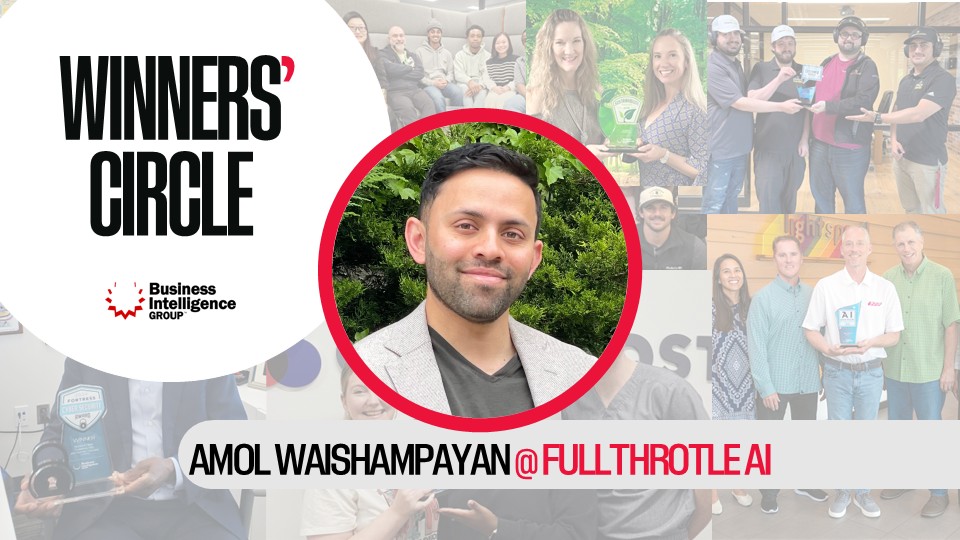
I know. It sounds like the kind of thing someone says right before they try to sell you something. But when Amol Waishampayan, co-founder of Full Throttle AI, laid it out on The Winners' Circle, it started making a lot more sense pretty quickly. And Amol has been doing this since 2018, so he's not exactly making things up as he goes.
The short version is this: when every advertiser in your category is bidding on the same paid search and paid social inventory, you're all just driving each other's costs up. It's an auction. More money in, higher price per click. Your cost per acquisition creeps up, your incrementality flattens out, and you're stuck defending a budget with diminishing returns to a CFO who just wants to see some actual outcomes.
That's the trap. And it's where a lot of mid-market brands are living right now.
The Google-Meta Trap and Why So Many Brands Are Stuck In It
So how did we all get here?
Amol's take is pretty straightforward. Digital advertising defaulted toward platforms that could show measurable results. Google gives you clicks. Meta gives you form conversions. When your CEO asks what you got for the budget, at least you can point to something on a dashboard.
The problem, as he put it, is that this kind of measurement rewarded the click and ignored everything that happened before it. You can measure the moment someone searched for your product and clicked your ad. You cannot as easily measure the CTV spot, the display impression, the podcast ad, and the direct mail piece that made them go search for you in the first place.
So the whole industry just sort of agreed to pretend those things didn't count.
The result is that 70 or 80 percent of most mid-market advertising budgets ended up parked in paid search and paid social, and the returns started shrinking for a pretty obvious reason. It's a bid market. When everyone floods the same channels, the price goes up and the performance goes down.
What Full Throttle AI does, at its core, is show you the whole journey. You can see that a household got exposed to a CTV ad, then a display ad, then a direct mail piece, and then clicked on your Google ad and bought something in a store three weeks later. Now you can start asking smarter questions, not just which click converted, but which combination of touchpoints actually drove the outcome.
Amol said it as clearly as I've heard anyone say it: the real question isn't just what's working. It's what's not working and what you can stop spending money on.
Household-Level Identity and Why the Cookie Never Mattered That Much Anyway
One of the things that makes Full Throttle AI genuinely different is that they built the whole thing without cookies. They decided to do that back in 2018, a little ahead of schedule, a little by instinct, and a little by luck depending on how you count those things.
But here's why it matters beyond the cookie deprecation conversation.
For a big chunk of mid-market advertising, the household is actually the right unit of measurement. Think about buying a car. You might put the loan in your name. Your spouse might test drive it. Your teenager might be the one who actually ends up driving it. The purchase could be registered under any of three different email addresses. A hashed email, which is how most ad tech platforms track attribution, is not going to give you a clean picture of that buying decision.
The household almost always is.
Full Throttle AI built a proprietary, cookie-free tag that identifies in-market signals at the household level and links devices across the household together. Amol described it well: you can see a signal jumping from an iPhone to a Mac in the same house and know you're dealing with the same buying intent. That's a very different kind of data than a clicked link.
And for the kinds of products mid-market brands tend to sell, anything that takes more than one day to think about and costs more than twenty dollars, household targeting is where the real signal lives. The AI-powered advertising platform for mid-market brands that can operate at that level of precision without being dependent on cookie data is solving a problem most of the ad tech industry has been trying to patch around for years.
Full Throttle AI also holds patents on this approach, filed starting around 2020, and they've been adding to that collection ever since. That's not the kind of thing you build as a feature sprint.
Agentic AI in Practice: From Intent to Campaign in Two Minutes
Amol is pretty thoughtful about what the word "agentic" actually means in a real product versus what it tends to mean in a press release.
His distinction is useful. There's a difference between AI-enabled and AI-powered. AI-enabled means someone took an existing platform and added a chatbot widget and a few AI-generated suggestions in the sidebar. AI-powered means the architecture was built around AI from the ground up, with guardrails, with agent coordination, with MCP servers talking to each other inside an actual ecosystem.
Most platforms claiming AI right now are, by his read, in the first category.
Inside Full Throttle AI's platform, agentic means a few specific things. Large language models are analyzing URL patterns and browsing behavior to determine purchase intent at the household level. A custom bidder is using that signal graph in real time to find the right devices and bid on the right inventory across CTV, display, online video, audio, podcasting, and direct mail, all at once. And outcomes, actual outcomes like cars sold, windows installed, solar systems purchased, are being matched back against the households that received those media exposures.
The campaign planning side is also fairly remarkable. An automotive dealer can describe a goal in plain language, like targeting customers with less than six months left on their lease plus conquest lookalikes in a specific market, and the platform will build the plan, price it, and launch it. Amol said that whole sequence can happen in two minutes.
He also brought up one of my favorite analogies in this space. The dentist and the hygienist. The hygienist does 95 percent of the work. The dentist comes in for five minutes, looks around, makes sure nothing's wrong, and sends you on your way. That's where human intelligence belongs in an AI-driven marketing workflow. Not gone, just repositioned. Doing the high-judgment work, not the repetitive mechanical work.
What the Automotive Industry Reveals About Where This Is All Going
Full Throttle AI has done a lot of work in automotive, and it's a good window into what mid-market advertising could look like across a lot of other industries.
The core problem for a car dealership is actually pretty simple: sell more cars, service more cars, do it better than the competitors around you. Everything else is just execution. And the same 80 percent Google and Meta budget trap that hits other mid-market brands hits dealerships just as hard.
Two of the use cases Amol walked through were pretty concrete. The first is lease renewal. A dealer pulls all the customers from their DMS who have less than six months left on their current lease, builds a lookalike audience of conquest prospects, layers in demographic targeting like Hispanic market inventory on Univision, and launches across CTV, display, and direct mail in one coordinated campaign. Every day, the platform shows how many new leases came out of that campaign.
The second is service reactivation. You take customers who haven't come in for service in two or more years, run a promotion across CTV, display, and a direct mail piece, and measure how many new repair orders came back in from people who had drifted away. Amol called these defected service customers, and bringing them back is actually one of the highest-ROI moves a dealer can make, because a customer who comes in for service is much more likely to buy their next car from the same place.
The bigger picture here is lifetime customer value. Dealer groups that own five or ten or three hundred stores across multiple brands need to think about whether a customer is staying in the family, not just whether they buy from this location this year. When you can see the full picture across all those touchpoints and measure outcomes at the household level, that question starts to get answerable in a way it never was before.
Human Intelligence Is Still the Variable That Separates the Winners
One thing Amol said that I think is worth sitting with.
He believes human intelligence will actually become more important as AI gets better, not less. His reasoning is that as AI becomes table stakes, what separates the people who use it well from the people who get mediocre results will be strategy and judgment. The same way some people are genuinely skilled at finding things on Google and some people are not, some marketers will know how to think with an AI platform and get dramatically better results than those who just let it run.
He also flagged a couple of mistakes he sees companies making right now. The first is not sense-checking AI outputs. People are using AI to generate drafts of marketing plans and just shipping them without adding a layer of human judgment on top. The second is the AI-enabled versus AI-powered confusion mentioned earlier. Companies are buying platforms that look AI-forward but are not architecturally built for it, and they're going to hit a wall.
His view is that AI is evolutionary, not revolutionary. The narrative says everything changes overnight. The reality is that every major technology has had an initial hype surge, then settled into practical adoption where the real improvements get built. That's where we actually are right now, and the brands that are making smart, strategic decisions inside that reality are the ones that are going to pull ahead.
Full Throttle AI has been operating in that space since 2018. That's not a short track record in a market this fast-moving.