




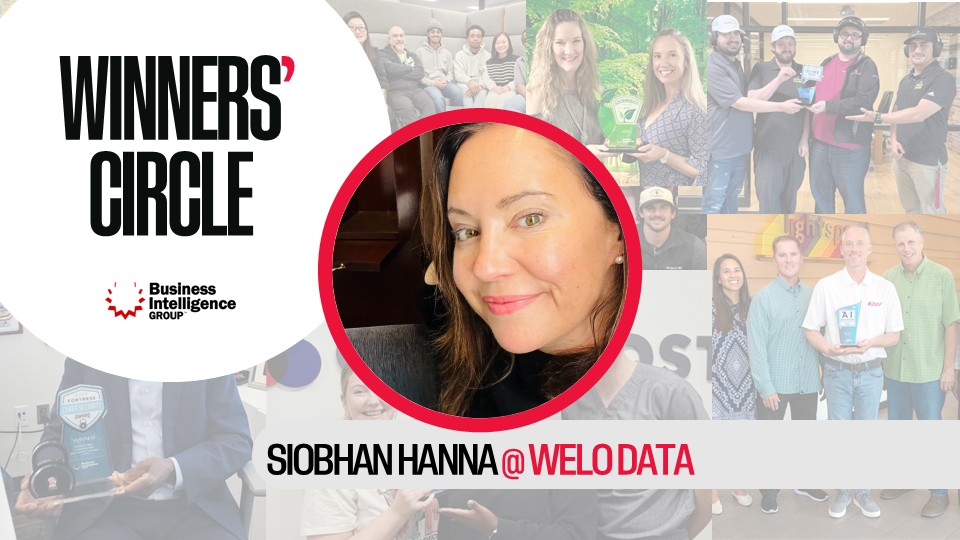

AI is moving fast, maybe a little too fast. So fast, in fact, that the industry has built a quiet blind spot right under everyone's nose. Engineers obsess over model performance and infrastructure scaling, yet a different kind of risk is quietly seeping into the data pipeline itself. Siobhan Hanna, SVP and General Manager of Welo Data by Welocalize, has been thinking about this problem for years, and her team just took home an AI Excellence Award for NEMO, the framework they built to fix it.
The Hidden Risk Sitting Inside Every Model
Here's the thing about fraud in AI, it isn't the kind that grabs headlines. We hear about deepfakes and prompt injection all the time, of course, but the threat Hanna is describing operates one layer deeper. It's really about the humans who produce the training data in the first place. Most foundational LLMs and enterprise AI tools rely on contractor crowd models, where globally distributed teams generate the judgment, nuance, and cultural context that makes models actually work. That kind of operation is naturally vulnerable to fraud.
The downstream effect, frankly, is brutal. When fabricated human judgments slip into a training set, they basically poison the model. Recent research from Anthropic showed that just 250 poisoned documents are enough to install a backdoor in modern LLMs, regardless of model size, which is honestly a wild stat to sit with. The really tricky part is detection. By the time a model starts producing degraded outputs, pinpointing where the fraud entered the pipeline can be nearly impossible.
Borrowing the Playbook From Financial Services
Welo Data didn't actually invent this problem-solving approach from scratch. Hanna and her team, naturally, looked hard at how financial services tackled fraud, and they pulled the best ideas into NEMO. For example, know your customer principles, real-time transaction monitoring, and behavioral analytics. The financial industry, after all, learned decades ago that point-in-time checks just are not enough.
What got translated really well, though, was the philosophy that AI training data integrity works the same way bank fraud detection does. It really demands continuous monitoring, not a single screening at onboarding. Traditional QA frameworks are designed to catch errors in the output, but NEMO flips that whole approach. It secures the environment where data is being generated, not just the data after it's been produced, which is honestly a different paradigm than most teams are operating with right now.
130 Behavioral Variables Beat a One-Time ID Check
Identity validation is hard pretty much everywhere on the internet. Try setting up a fake Facebook account today, and you'll basically get nowhere fast. So why is fraud detection so much trickier in AI training data? Hanna's answer, basically, is the sheer pace and complexity of the AI environment, plus the global, multilingual nature of the contributor pool.
NEMO monitors a little over 130 unique behavioral variables per session. We're talking timing patterns, interaction signatures, cross-session consistency, and other signals that hint at things like account sharing or coordinated manipulation. The framework runs three layers in parallel: rules-based logic for known threat patterns, AI-driven detection for the novel and evolving stuff, and finally behavioral psychology, which Hanna says is the underappreciated part of the whole picture.
That last layer is honestly fascinating. Welo Data, of course, has an actual organizational psychology team inside its fraud mitigation organization. They study human motivations and behavioral markers behind fraud, which makes the detection significantly more accurate than purely technical signal analysis would be on its own.
The Multilingual Problem Most Teams Underestimate
Here's a wrinkle that gets glossed over a lot. Welo Data operates across more than 100 markets. A fraud detection model that works in one language does not actually translate to 103. Cultural context, naturally, shapes how fraud presents itself. Behavioral patterns that look completely normal in one market can look anomalous in another, and the reverse is just as true.
That's where Welo Data's network of 500,000-plus expert evaluators across 105 countries actually starts to matter. They aren't just providing labels and judgments. They're providing the cultural calibration that actually lets a fraud detection system understand what "normal" even looks like in a given context. The security model itself has to be adapted for the needs of different markets, and that work is really not trivial.
What Founders and AI Leaders Should Do Right Now
So if you're a founder, operator, or AI leader, what do you actually do with all this? Hanna's answer is pretty practical. First, AI integrity does not manage itself. It needs sustained investment and strong governance, plus a genuine belief that the human layer of AI development is worth protecting in the first place.
Next, get serious about data provenance. Who actually produced the data your models train on? Are those experts actually verified? Then check what the audit trail really looks like. These really should be standard questions in every vendor evaluation, the same way more mature industries handle supply chain compliance and risk.
And finally, do not assume the regulatory side will save you. Right now, contributor verification and data provenance are not formally mandated, yet conversations in Brussels and Washington are clearly heading in that direction. The companies who actually treat AI training data integrity as a discipline now will be the ones already compliant when the rules catch up.
Russ has spent decades watching technology shift markets, from his early days in printed newspapers to the telecom and content strategy work that came later. The pattern is pretty consistent: the industries that win are the ones that take quality and integrity seriously before they're forced to. AI is just the latest version of that same story. Hanna and the Welo Data team are betting that data integrity will be the next major battleground, and honestly, that bet is looking pretty smart.
Enjoying insights from industry leaders? Subscribe to The Winners' Circle podcast on your favorite podcast player and never miss an episode. Listen and subscribe at bintelligence.com/podcast.