





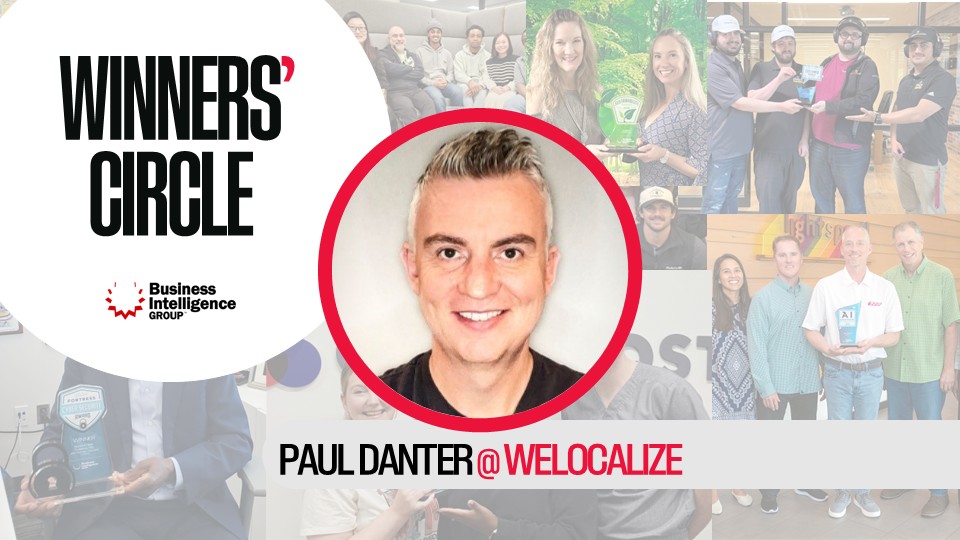

So here is a problem that almost nobody outside of marketing ops is really thinking about today. Enterprise teams are now generating content at a pace that, frankly, no human review process can keep up with. The "AI made it, ship it" instinct is everywhere, just behind the scenes of every marketing team. And nobody seems to ask what happens when a Fortune 500 brand suddenly sounds like a generic chatbot in 35 different languages. Welocalize, the longtime localization veteran, basically built the answer to that quiet crisis. Their Opal platform actually just won the 2026 AI Excellence Award from Business Intelligence Group, and the technology behind it is a bit of a masterclass in what production AI looks like when the stakes are real. Paul Danter, the GM at Welocalize, actually described the build as the result of a huge team investment in operationalizing AI at enterprise scale.
The interesting part is that the language industry has, in fact, been quietly running production AI longer than virtually anyone else. The second L in LLM literally stands for language, of course, and the original neural machine translation engines were doing predictive AI work back when most marketing teams still thought ChatGPT was a typo. Now, with generative AI sitting on top of those older neural networks, something fundamentally different is just happening. The output is so good that the bottleneck has, more or less, moved somewhere else entirely.
The Tsunami Nobody Is Talking About
So the real story of enterprise AI in 2026 is not that the models got smarter. It is that the volume just exploded. Danter put it perfectly when he said companies are about to have a "moment in a few months" where they wake up and realize their token spend is completely out of control, just so anybody with a tool can now generate content faster than anyone can review it.
This actually tracks with what Gartner predicted back in 2022, where the firm said by 2025, 30 percent of outbound marketing messages from large organizations would be synthetically generated. That number actually feels low now. Most enterprise marketers I have talked to since starting Business Intelligence Group basically describe a flood: more variants, more campaigns, more landing pages, just multiplied by 30 languages. Like, the headcount math actually stops working pretty quickly.
For my Six Sigma brain, this is virtually a textbook process gap. You can have the best models in the world, yet the entire pipeline collapses if there is no governance layer in front of them. Welocalize seems to have figured this out earlier than most. The "operationalization" angle that Danter kept coming back to is not really a buzzword for them. It is in fact the product itself.
Why Good Enough Is Not Good Enough For Brand Voice
So here is where it gets interesting. Most generic AI translation tools are pretty fluent at this point in 2026. The grammar is usually fine. The terminology is mostly fine. What they are still really bad at is sounding like a specific brand. A running shoe company has a tagline that just needs to land. A B2B SaaS company has a particular tone of voice that took the marketing team five years to land on. A generic model basically flattens all of that into something that reads like a translated insurance disclosure.
Opal solves this with a layered approach that actually works. Neural machine translation does the first pass, just like before. Generative AI then actually post-edits the output, this time trained on the brand's specific voice, terminology, and tone. Quality estimation happens before any human touches it, so the right content gets routed to the right reviewer. A linguist annotates the corrections, and that annotation feeds reinforcement learning that just makes the next batch better. It is a closed loop that, in production, has cut turnaround time by 50 percent and reduced human post-editing effort by 26 percent, according to Welocalize's internal data.
For directors of marketing trying to defend ROI on localization spend, those numbers really matter. As CSA Research has noted in its annual industry analyses, the language services market just keeps growing as enterprise content production scales faster than human translation capacity can. AI translation is virtually the only reasonable way out, just so long as the AI sounds like you.
Quality Before The Edit, Not After
So the thing I really loved about Opal is that the quality estimation step happens before the human gets involved, not after. This is virtually backwards from how the language industry has operated for decades. Traditionally, you translate, then a linguist post-edits, then a quality scoring exercise happens on the final output, often weeks later. Opal just flips the order.
This actually matters for two reasons. First, it lets the system route low-risk content (a support article on rebooting your cable modem) straight through with minimal human intervention. Second, it actually concentrates human effort on the high-stakes stuff: marketing copy for a product launch, regulatory disclosures, that running shoe tagline. Danter calls this "content risk management" and it is, frankly, a really mature way to think about AI in the enterprise.
He said something else that really stuck with me: "what we have tried to do is to think about the possibility that AI offers us in terms of being able to do that translation work in an optimal way that represents a brand really well." That word optimal is just doing a lot of work in that sentence. It is actually not maximal AI. It is, instead, the right AI for the right content at the right time, which is in fact much harder to engineer than throwing every job into one big model.
From Risk-Scored Content To Living Marketing Systems
So here is where Danter got really visionary. He predicted that in five years, content will not just be translated. It will actually be regenerated automatically based on how it performs in each market. Picture an AI agent that notices your German PPC ad has a terrible click-through rate, rewrites the copy in a way that still represents your brand, republishes it, and just measures the lift. That is not science fiction. The plumbing for that is basically all in place right now.
McKinsey's 2025 State of AI report actually found that high-performing AI organizations are now redesigning workflows around AI rather than just bolting AI onto existing workflows. Opal is in fact a really clean example of that pattern. The system is not just a translation tool with AI inside. The whole pipeline has, in fact, been rebuilt around what AI can do well, with humans placed exactly where they add the most value (annotation, judgment, brand stewardship) and not really anywhere else.
For account executives at PR agencies trying to figure out how to talk about AI to clients in language they will actually believe, this is, like, the angle. It is not really "AI will replace your team." It is in fact "AI lets your team operate at a scale that you could not staff up to in real life." That story actually sells in 2026.
What Every AI Builder Should Take From This Win
So whether you are in the language services space or really anywhere else, Opal is a model worth studying carefully. The big lessons, in my view: just build expert systems trained on real brand data, score quality before humans touch it, route content based on risk rather than just file type, close the reinforcement loop with annotated human corrections, and never lose sight of the fact that the model is in service of the brand, not the other way around.
Danter joked that the future might really be the billion-dollar single-person company, where one founder uses expert AI agents for every part of the operation. Welocalize is virtually building the language layer for that future right now. They have semantic coherence baked into the post-editing loop, entity-based authority through brand-specific training, and a measurement scheme that just tells you whether the AI made the content better or worse.
For my money, that is what a 2026 AI Excellence Award should actually look like: production AI in the real world, real revenue impact, a clear human-in-the-loop philosophy, and a roadmap that sounds more like an operating system than a feature list. So congratulations to the whole Welocalize team. The bar just got raised for the rest of the industry.
Enjoying insights from industry leaders? Subscribe to The Winners' Circle podcast on your favorite podcast player and never miss an episode. Listen and subscribe at bintelligence.com/podcast.