






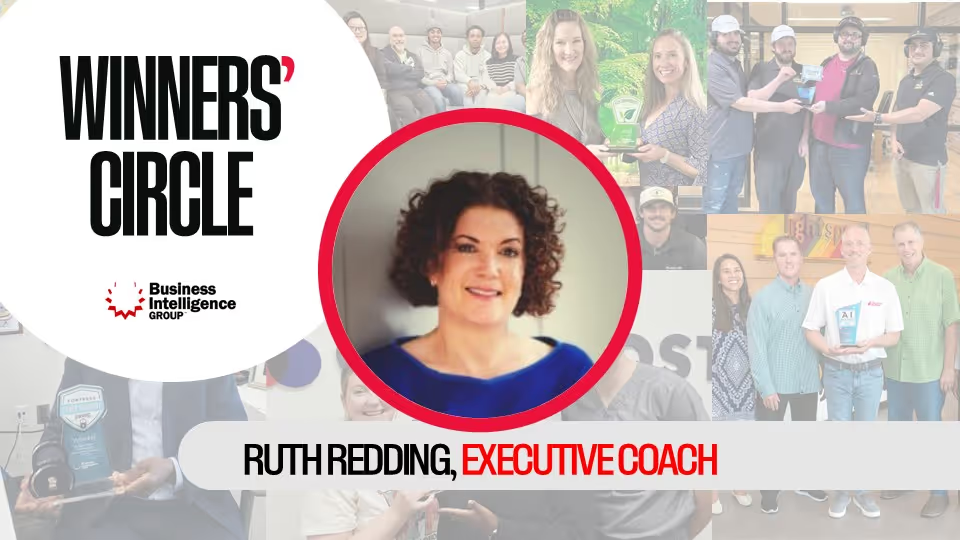

Ruth Redding has been through eight major mergers and acquisitions. Not the small ones where a company acquires some automation capability or an ethernet provider. Eight really big coming-together-of-two-organizations moments where everything changes and nobody knows what happens next.
Most people go through one or two of these experiences in their career and find it traumatic. Ruth went through eight and basically turned that experience into a superpower. She runs a coaching consultancy at ruthredding.com and serves as an Associate at Cambridge Management Consulting, helping executives and companies navigate the exact situations that used to keep her up at night.
Her Change Accelerator Program exists because, as she puts it, she would have loved this program 15 years ago when she was going through these transitions without a roadmap.
The Fight or Flight Problem Nobody Talks About
Here's what really happens psychologically during a merger: your brain goes into fight or flight mode. Thousands of years ago, that response system activated because you were being chased by a tiger. Now it activates because your company is being merged with another organization, and you have no idea if you'll have a job in six months.
When you're in that threat state, your brain functions completely differently. It focuses entirely on the danger and basically stops making quality decisions about everything else. You're not doing the same caliber of work. You're not thinking strategically. You're surviving, not thriving.
The first challenge is actually recognizing that you're in a threat state. Until you recognize it, you don't know you're in it. You just think you're stressed or having an off week. But really, your entire cognitive function has shifted into protective mode.
The second challenge is building resilience and confidence so you can get out of that threat state and continue doing great work. Because the people who keep performing well during mergers are the ones who get noticed and stay employed as the organization restructures.
Anxiety Lives in the Gap Between Control and Uncertainty
There's a useful definition of anxiety that frames it around control and uncertainty. Higher levels of uncertainty combined with lower levels of control than you're used to creates that anxious feeling. During managing organizational change like M&A, you're simultaneously dealing with massive uncertainty and almost zero control over the big decisions.
It's not just your mental health at stake. You're legitimately trying to keep a roof over your head and food on the table. The stakes are real, whether you ultimately get laid off or not. Just not knowing is often the worst part.
And this affects everybody in the organization. Whether you're at the top level, middle management, or entry-level, everyone feels that threat. It's just that not everybody shows it. People might be acting in unusual ways, behaving strangely for them. If you take a step back, you realize they're probably feeling the same level of threat you are.
Building up that awareness helps people empathize and understand that everyone else is going through it too. The executive who seems short-tempered? The colleague who's suddenly quiet? They're in their own version of fight or flight.
The Cloverleaf Approach to Building Empathy
One of Ruth's core tools for helping people understand each other during change is Cloverleaf, an AI-powered coaching platform that builds up a picture of your strengths and psychological profile. It then creates a team version where you can see your teammates' strengths, how they respond to change, how you respond to change, and how those responses might differ.
When you understand where someone else has come from, what their version of the world is, and what their strengths are, you naturally build more empathy. It's harder to assume the worst about someone when you can see that they're wired differently and experiencing the same stress through a different lens.
Ruth uses both the online version and face-to-face sessions with her clients to help them understand themselves and each other through the change process. Understanding builds empathy. Empathy builds teamwork. Teamwork gets you through mergers intact.
Interestingly, Cloverleaf itself is an AI-based platform. It gives you daily output driven by artificial intelligence, and Ruth believes there's a place in her coaching role for a combination of human and AI support. If something as fundamentally human as coaching can be a dual role between AI and human expertise, then there's probably a place in everyone's role for some element of AI assistance.
The Three Circles That Actually Help
Here's what Ruth tells executives facing a merger announcement: draw three circles. Small circle, slightly bigger circle, slightly bigger circle.
The smallest circle is your circle of control. These are things you can absolutely control today. You can control what time you get out of bed. You can control showing up to every meeting on time, technology permitting. You can control coming across in a positive way. You can control your effort and your attitude.
Think about those things every day. Focus there.
The next circle is your circle of influence. These are things you can have some influence over, and you should think about this every day too. You can influence what your boss thinks of you. You can influence what the person three offices down thinks of you. You can influence how good a service your clients receive. There are things you can influence daily in your role.
Focus on those two circles: control and influence.
The big circle at the edge contains things totally out of your control. The board's decision about which offices to close. The timeline for the integration. Whether your department gets restructured. If you keep focusing on that outer circle, your anxiety will stay sky-high.
Don't think about that circle, or think about it maximum ten percent of your time. Keep your focus on what you can control or influence. That focus brings your anxiety down because you're concentrating on actionable things rather than spiraling about decisions you'll never influence.
Stay Visible or Disappear
The second critical tip: stay visible. The worst thing you can do during uncertainty is keep your head down and just get on with your work under the radar. That strategy might feel safe, but actually makes you vulnerable.
You need to be visible to the right people. Make sure you're showing up. Turn your camera on for calls even when you don't want to. Show up with a positive attitude. Engage actively. Stay visible every day.
This goes against every instinct when you're anxious. You want to hide. You want to avoid attention. You want to just do your job quietly and hope nobody notices you enough to put you on a layoff list. But invisibility during change is actually the riskier strategy.
The people making decisions about who stays and who goes are watching for engagement, attitude, and contribution. If they can't see you, they can't advocate for keeping you.
Know Your Strengths and Share Them
The third tip: really think about what your strengths are and where you want to go. Take advantage of the fact that there's usually a bit more time between announcements when things are unsure. You're in limbo anyway. Use that time productively.
Think about what you're really good at. Think about what you actually want to do. Then share that with people. When you're being visible, share it. Share it with your boss. Share it with someone you're having coffee with. Make sure you're communicating those strengths and your desired direction internally.
This isn't about being pushy or self-promotional in an uncomfortable way. It's about making sure the right people know what value you bring and where you could contribute as the organization evolves. If nobody knows you're excellent at client relationships, nobody will think to put you in the new client success role they're creating.
Why This Program Exists Now
Ruth's coaching practice launched early last year, and she quickly realized a lot of people were coming to her specifically because they were going through M&A processes. Instead of just doing one-on-one coaching, she decided to create structured programs to help both individuals and companies through transformation.
The Change Accelerator Program works both for individual executives navigating personal uncertainty and for companies trying to keep their teams functional during major change. It's rooted in Ruth's 25 years of experience, starting with her very first job when the company merged with another organization. Her second job, same thing. Eight major M&As later, she has pattern recognition about what works and what absolutely doesn't.
Some of those experiences were great. Some were really rough. But all of them taught her something about how humans respond to organizational upheaval and what support actually helps versus what just sounds good in an HR memo.
Change Isn't Always M&A Anymore
Here's an interesting evolution: change isn't just about mergers anymore. The conversation around AI implementation represents another massive organizational shift where people feel anxious about their roles and uncertain about their future.
If "Chief AI Officer" wasn't the title of the year in 2025, it's certainly going to be ubiquitous in 2026. As those roles become more common and companies AI-ify their operations, people will experience similar psychological responses to traditional M&A. The same anxiety about displacement. The same uncertainty about what skills will matter. The same need for tools to stay grounded and focused on what they can control.
Ruth's program and framework apply equally well to AI transformation as they do to corporate mergers. The psychological experience is similar: big change you didn't ask for, uncertainty about your place in the new structure, and a need to manage your own response while continuing to perform at a high level.
Recognition Through Change
Ruth serves on the advisory board for the Heorizon Awards and has guest-hosted winner interviews. She emphasizes that recognition becomes especially important during change. Recognizing the people who are making transformation happen. Celebrating teams who are navigating uncertainty while still driving innovation.
The Heorizon Awards focus on people who are changing things up wherever they work. Many of the winners are leading transformation in challenging circumstances, often with limited resources and high stakes. That kind of leadership deserves visibility and celebration.
Recognition also matters for the individuals going through change. When you're uncertain about your value during a merger, being recognized for your contributions can be psychologically critical. It reinforces that you're seen, you're valued, and you have a place in whatever comes next.
The Reality Check We Need
There's an interesting tension in modern life: we're flooded with information about change happening everywhere. Social media, news feeds, Instagram videos, all showing us constant upheaval and transformation. It can feel like the entire world is in chaos all the time.
Ruth offers a useful reality check: most of the world is not going through that specific change. It's not happening to you personally. It's not happening around you right now. It might be a nice sunny day, or a greay day in the UK, and fundamentally your immediate world is stable.
Change is happening, but it's not always happening to us personally. It's not always happening around us. Yet it sure seems like it most of the time because of how information reaches us. That's the big circle of things outside our control. The stuff we consume through media that makes us anxious but doesn't actually affect our day-to-day reality.
Focus on your two inner circles. That's where your actual life happens.
Simple Lessons That Save Anxiety
These are simple frameworks. Three circles. Stay visible. Know and share your strengths. But simple doesn't mean easy, and simple doesn't mean ineffective.
Ruth wishes she'd known these lessons 15 years ago during her early merger experiences. The anxiety she could have saved herself. The energy she could have redirected from worry into productive action. That's why the program exists now.
For executives facing organizational change, whether it's M&A, restructuring, or AI transformation, the psychological playbook is similar. Recognize when you're in fight or flight. Understand what you can control versus what you can influence versus what you can't affect at all. Stay visible. Know your value and communicate it clearly.
And maybe most importantly: recognize that everyone else is going through their own version of the same stress. Build empathy. Support each other. Navigate it together.
That's what Ruth Redding's Change Accelerator Program offers: practical tools grounded in lived experience, delivered by someone who's been through it eight times and came out the other side with wisdom to share.
Be sure to like and subscribe to our podcast to stay updated on the latest insights into navigating change and building resilience in your organization.