








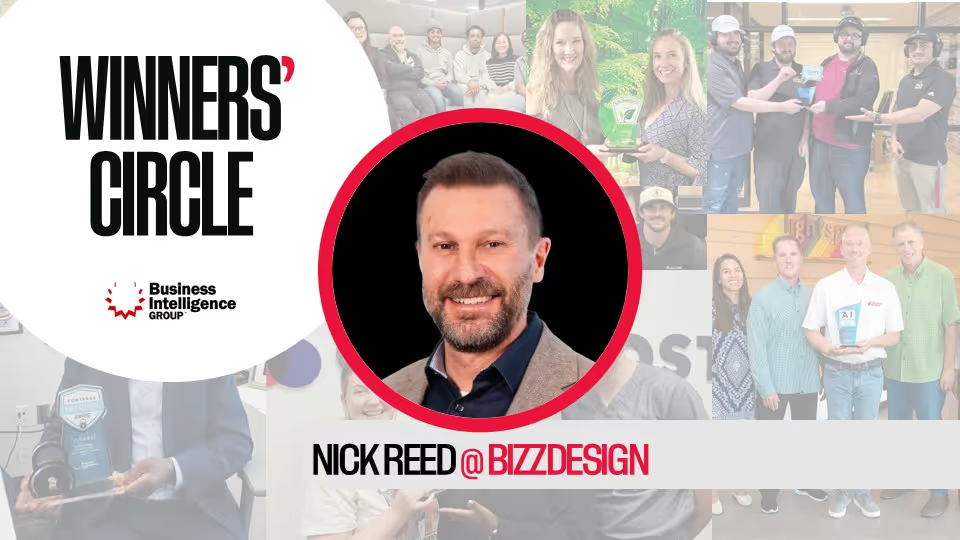

It takes a certain confidence to run a transformation company while undergoing your own massive transformation. Bizzdesign did exactly that, merging with two former competitors of similar size to triple the company in revenue and more than triple in headcount.
Nick Reed calls it drinking your own champagnedo . The enterprise transformation software company now operates across 19 countries, and the merger forced them to apply every principle they preach to their customers.
Why 83 Percent of Transformations Fail
The statistics on digital transformation remain brutal. Research from Boston Consulting Group and McKinsey consistently shows that 70 percent of digital transformation initiatives fail to meet their objectives. More recent analysis from Bain puts the number at 88 percent failing to achieve their original ambitions.
Reed sees where the failures start. "Most transformations fail at the start," he explained. "It's a combination of taking too long to get mobilized, just running around for months, trying to find the data to plan the thing in the first place. Second, it's misalignment of stakeholders. People leave the workshop, everyone thinks they're on the same page, but they leave with completely different understandings of what they're actually going to do going forward."
The third failure point is cost and time overruns from emerging impacts and dependencies that were not foreseen upfront. That is when rework begins, delays multiply, and business cases collapse.
"That's where business cases go out the window," Reed noted. "And so we're all about helping manage that complexity upfront so that everyone gets aligned around shared roadmaps and you don't run into those unforeseen consequences of change."
Enterprise Architecture as the Solution
Enterprise architecture represents the discipline of creating models that help large complex organizations understand how their moving parts connect. Business capabilities link to processes, processes depend on people and technology, technology relies on data, and all of it needs to change to realize strategic goals.
"When the chief exec of a company says, okay, we need to pursue this certain strategy, you can map that onto the things that the business does," Reed explained. "And then understand what do those processes depend on? What people, what data, what technology, and how is that going to change in the future to realize strategic goals?"
The real value emerges in understanding cascading impacts. Change one thing and you need to understand what else gets affected. Which teams might be impacted? What downstream systems depend on that process?
"That's usually where all the friction comes in, where you get these unforeseen impacts that slow you down and cause rework, overruns," Reed said.
The AI Sprawl Problem
With global AI spending projected to reach $2.5 trillion in 2026 according to Gartner, organizations face a new challenge: coordinating all the experimentation happening across the enterprise.
"One of the first things that happens is everybody gets busy experimenting, trying new tools, gets the credit card out, signs up for ChatGPT or Gemini or Copilot or whatever," Reed observed. "And then someone says, hang on a minute, am I doing something that someone else is already doing?"
The questions compound quickly. Are we using the same tools or different tools? Who is spending what? Is it compliant with security and privacy policies? How much of this activity actually contributes to strategic goals?
Reed calls this AI sprawl. Lots of activity, but uncoordinated. The solution involves getting visibility of what is going on, mapping initiatives to business capabilities, identifying duplication, and understanding which tools meet compliance requirements.
"When you find an experiment that works, you can then scale it across the organization, across all the teams that might benefit from it, as opposed to it just happening in a silo and limiting the ultimate value you're getting from it," Reed said.
Governance in an Agentic World
The emergence of AI agents introduces new governance challenges. Human governance depends on humans reviewing and approving decisions. But agents operate dynamically, faster than humans can process.
"When it's agents doing it, it's happening dynamically in real time, faster than humans can actually deal with it," Reed explained. "So the nature of governance is going to change where in an agentic world, we're going to need to actually write down our governance rules and principles and policies as code or as data that those AI agents can understand and provide those guardrails."
The shift represents a fundamental change in how organizations think about control. Guardrails need to be explicit and machine-readable, established upfront rather than applied after the fact.
According to Deloitte's 2026 State of AI in the Enterprise report, nearly three in four companies plan to deploy agentic AI within two years. Only one in five report having a mature governance model for autonomous agents. That gap between adoption and governance creates risk.
The 10x Mandate
Reed shared a conversation with a recent customer. The mandate from their board: 10x the speed from idea or vision to value running in production. Not incremental improvement. Massive acceleration in how they plan, design, govern, and execute transformation.
"That requires thinking about what can be automated," Reed said. "How can the data that exists around the enterprise be made available to the people that need it?"
Generative AI helps with accessibility through natural language conversational interfaces. But Bizzdesign is also thinking about how to multiply the impact that enterprise architects can have by automating lower-value work so they can focus on high-value activities: understanding stakeholder needs, advising on trade-offs, providing governance around how new solutions support the business.
"We're not just kind of 10xing the speed, but we're 10xing the coverage of those teams to support more transformation in the enterprise," Reed explained.
The Three-Way Merger
Bizzdesign's own transformation involved merging with two former competitors: Mega International, strong in France, Italy, and Latin America, and Alfabet, headquartered in Germany with strength in Germany, Austria, Switzerland, and the Middle East. Bizzdesign brought strength in Benelux and the UK.
"The geographic fit between the companies was actually really nice," Reed noted. "Each of the three companies had strengths in different geographies."
The technology and systems integration, while not trivial, was not the hard part. "Those cultural aspects are actually super important," Reed said. "And I would say that the technical aspects, the technology aspects of merging while not trivial, are not the big thing."
The company recently held an all-hands event, bringing everyone together in one place. Reed described the energy, alignment, and connections forming across teams, geographies, and former company lines. CRM systems merged into one. Back office finance consolidation continues. One brand, one operating model.
Three Pillars of Transformation
Bizzdesign organizes its approach around three pillars: transformation planning, transformation design, and transformation governance.
Planning aligns portfolios of initiatives, applications, and technologies in support of business goals. Design architects what the future enterprise should look like across business, data, and technology, connecting the dots across different areas. Governance ensures benefits are realized in business operations and proper controls exist around the transformation.
The three products in Bizzdesign's suite naturally align with these pillars. And with AI becoming mainstream, the company is building connective tissue across the products to engage more users who can extract value from existing data.
Where Transformation Starts
One insight from customer research surprised Reed. For the kind of work Bizzdesign supports, historically, the tooling has been expert tooling used by architects of various types: business architects, solution architects, technology architects, enterprise architects.
"Many business stakeholders wouldn't really use this kind of tooling," Reed acknowledged. "And actually when you look at where transformation starts, it's not purely top-down from the C-suite and the strategists. It's also bottom-up, emerging from people who are doing day-to-day operations who spot opportunities to improve."
Transformation often begins in workshops with sticky notes on walls or virtual whiteboards. People collaborate, throw ideas around, map changes they want to see. But a disconnect exists between where transformation starts and where it gets analyzed and planned in structured architecture tools.
Bizzdesign is bridging that divide. The goal is connecting all stakeholders in an engaging, freeform environment while maintaining access to the governed repository of enterprise information. When someone wants to transform customer service, they can have the whiteboard but also pull in current processes, who operates them, which technology and data they use. Then they can sticky note around that foundation and architect change together.
The Building Analogy
Reed compares enterprise architects to building architects. Both understand demands, needs, and constraints. Both find the best trade-offs between what the customer wants, what they are prepared to pay for, and what time allows. Both ensure work happens in the right order.
"The key difference in our world from building a building is everything's changing all the time while you're in motion," Reed noted. "And I think that's the key thing in many ways of our profession. Planning and design and execution while all the moving parts are changing continuously along the way."
Just like building a house, transformation projects face predictable overruns. You discover things you did not know. But unlike building a house, the foundation keeps shifting.
Looking Ahead
Reed sees the current moment as a historic inflection point, similar in nature to the Industrial Revolution and the emergence of computing. Exciting. Potentially scary. No one knows the full impact.
"The last 20 years have been about digital technology, digitizing business," Reed reflected. "The next 20 years will be about putting intelligence into everything we do. This is not a fad you can get out of the way of."
For leaders considering transformation, Reed's advice is straightforward: get busy with experiments. Any organization not running AI experiments risks being left behind. But he emphasizes context. AI models need context to improve their reasoning. Enterprise information about assets, relationships, and dependencies provides that context.
"Having a model context protocol server that these enterprise AI tools can connect to to get that context we see as an important part of what we're doing going forward," Reed said.
The transformation company has transformed itself. Now the work continues: helping customers navigate the same journey at accelerating speed.
Enjoying insights from industry leaders? Subscribe to The Winners' Circle podcast on your favorite podcast player and never miss an episode. Listen and subscribe at bintelligence.com/podcast.