





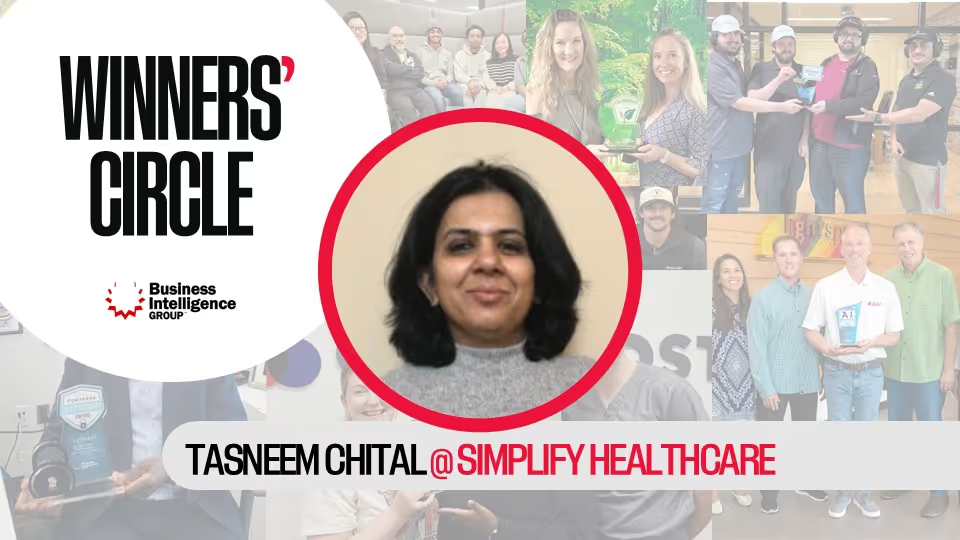

Documentation in healthcare is basically treated as an afterthought until something goes spectacularly wrong. Teams work nights and weekends during open enrollment, applying brute force to get documents out the door. As long as everything looks fine, nobody pays attention. But the minute there's a violation or member complaint? Suddenly there's chaos. Leadership demands answers, CMS wants explanations, and it becomes catastrophic. Tasneem Chital, who is the VP, Product Management, Government Markets at Simplify Healthcare, recognized this pattern while working for over a decade at the intersection of product, compliance, and operations - and decided to actually fix it.
"It's more of a last mile thought process. Nobody really thinks of it right from the start," Tasneemexplains. "And it's more of get this administrative job done versus thinking of it as a regulated communication piece."
But here's the thing that tends to surprise people - these documents aren't just administrative paperwork. Summary of Benefits documents, Evidence of Coverage, all of these are actually legal documents. Beneficiaries use them to make coverage decisions and understand their medical coverage. CMS audits against them. They matter enormously. Yet there's no single source of truth, no system of record automating the entire journey.
Simplify Healthcare’s Simplify Docs™ just won the 2025 BIG Awards for Business Product of the Year award for changing that equation, and their approach is pretty fascinating.
The Brute Force Problem
Teams across the healthcare payer industry are working in silos, each thinking about individual tools to fix their specific problem, but nobody's holistically thinking about automating things end-to-end. Product teams compile materials, then coordinate with compliance teams, legal teams, and marketing teams. Documents go to translation vendors, then print vendors, then potentially another vendor for large print formats, then through an entire distribution system.
"It was a very, very disjointed process," Tasneem notes. The margin for error keeps shrinking too. CMS isn't just checking boxes anymore - they're going deep on accuracy of member materials, verifying that plan data is correct, ensuring translations work in ways members can actually understand.
The End-to-End Lifecycle Nobody Was Automating
Healthcare documentation automation starts with documents that need to be created annually. Then you've got CMS regulations coming out that require compliance. Plan data needs to be incorporated. All that information needs to be correct and in a language that members can understand.
"If you're serving all of the service areas that speak other languages, there is a whole aspect of translation. Just the English interpretation of these documents is so difficult - imagine explaining something like prior authorization or the maximum amount of pocket (MOOP) and all of this terminology in all of these different languages."
Not only does translation need to be linguistically correct - it needs to be culturally relevant. Medical terminology is complicated enough in English. Translating concepts like prior authorization or out-of-pocket maximums into multiple languages while maintaining cultural context is genuinely challenging.
Then you layer on accessibility requirements. Documents need to be available in multiple formats - standard print, large print, digital text versions. Each format requires different handling, different vendors, different quality checks.
The teams managing all this are experiencing serious burnout. Nights and weekends during open enrollment season become routine. The work is intense, deadline-driven, and if anything goes wrong, the consequences are severe. Yet until recently, nobody was really thinking about how to systematically improve this workflow.
The Product Design Challenge
Building products for regulated industries creates an interesting tension. Tasneem’s approach focuses on understanding what people actually do versus what they say they do. "A lot of times when we design products, we don't understand the need or the pain point correctly," she explains. Product teams might build what users request without recognizing the real underlying problem.
Simplify Healthcare spent time deeply understanding the workflow. They mapped the entire documentation lifecycle, identified where manual work was happening, understood where errors typically occurred, and recognized which parts of the process caused the most stress.
The solution needed to handle multiple complex requirements simultaneously. Regulations change annually and need to be incorporated. Plan data needs to be accurate and properly formatted. Translations need to be correct across multiple languages. Compliance checks need to happen throughout. Quality assurance needs to catch errors before documents reach members.
"We thought that while we've had experience automating other aspects in the healthcare industry, the idea was that this invisible infrastructure of documentation, which nobody's really looking at, you do this right, we could really operationally change the way the payers and the other organizations in the regulated industry are working today," Tasneemsays.
The AI Integration Approach
Simplify Docs™ is an end-to-end system of record for healthcare documentation. Rather than patching together individual tools, they created a platform that handles the complete lifecycle.
AI plays a role throughout, but it's implemented thoughtfully rather than just slapping AI onto everything. Tasneem talks about moving from POC and sandbox stages to having AI as "an operational certainty" in products. That's a significant distinction. Experimentation is fine, but you need real operational reliability for something as critical as healthcare documentation.
"Once you adopt automation, once you adopt more of AI, you put that in your operations, then what's really going to separate people out is who has got governance, the right processes of validation and trust baked into their overall operations," she observes.
"I think that's going to be a differentiating factor."
The platform handles authoring, validation, and interaction with documents and content. It incorporates compliance checks, manages translations, coordinates accessibility formats, and tracks everything through distribution. Rather than information living in disconnected silos, there's finally a single source of truth.
The results speak for themselves. Clients are seeing 50% savings in turnaround time and 40% reduction in translation costs. But what really validated the approach for Tasneem was watching documents generated through Simplify Docs™ actually get distributed to members during open enrollment. It wasn't just a lab experiment - the product worked in real-world conditions.
The Strategy Game Nobody Was Playing
What Simplify Healthcare really recognized is that documentation should be a strategy game rather than a last-minute scramble. Teams need to think about documentation workflows from the start, embedding them into operations rather than treating them as an afterthought.
Translation offers a perfect example. Many organizations still think about translation only after completing English documents. But if you're building a documentation strategy from the beginning, you're considering multilingual needs, cultural context, and accessibility requirements throughout the entire process.
The invisible infrastructure metaphor is apt. Nobody thinks about plumbing until pipes burst. Nobody thinks about electrical systems until power goes out. Healthcare documentation was similarly invisible - functioning quietly in the background until catastrophic failure made it impossible to ignore.
By making this infrastructure visible and automating it properly, Simplify Healthcare is reducing risk, enabling scale, and reducing burnout. More importantly, they're ensuring beneficiaries get accurate information, which is ultimately what matters most.
The Human Stories Behind the Metrics
Numbers like 50% time savings and 40% cost reduction are impressive. But what really validated the product for Tasneem were the human stories. Teams working nights and weekends suddenly weren't. Stress levels during open enrollment decreased. Errors caught before reaching members increased. People could actually focus on strategic work rather than drowning in manual processes.
This mirrors patterns I've observed over decades in marketing and tech. When you remove the administrative burden from knowledge workers, they can actually apply their expertise where it matters. Salespeople can sell. Doctors can see patients. Product teams can build better products instead of manually processing documentation.
The automation isn't replacing human judgment - it's eliminating the tedious, error-prone manual work that prevented humans from applying their judgment effectively. That's the difference between AI that actually helps versus AI that just adds complexity.
Where This Goes Next
Tasneem hopes for broader adoption of simplified documentation strategies across healthcare payers. The goal is shifting the organizational mindset from treating documentation as a compliance burden to recognizing it as strategic infrastructure.
The platform will continue incorporating more AI capabilities, moving from experimentation to operational certainty across authoring, validation, and interaction. But the real differentiator will be governance, trust, and proper validation processes.
As healthcare payers face increasing competition and evolving CMS regulations, having a robust documentation infrastructure becomes more critical, not less. The organizations that figure this out early will have significant advantages over those still applying brute force techniques to push documents out the door.
The invisible infrastructure is becoming visible. The afterthought is becoming a strategic priority. And teams that were burning out on manual processes finally have workflows that actually help rather than creating more work. That's what Product of the Year recognition looks like when you solve a problem nobody else was addressing comprehensively.
For marketing directors and operations leaders managing complex documentation workflows in regulated industries - healthcare, financial services, insurance, anywhere compliance matters - the lessons here apply broadly. Fixing invisible infrastructure requires understanding the complete lifecycle, building true end-to-end solutions rather than patching point problems, and implementing AI with proper governance rather than just chasing the hype.
The teams at Simplify Healthcare figured this out. The healthcare payers using their Simplify Docs™ platform are seeing real results. And the rest of the industry is starting to recognize that documentation isn't just an administrative afterthought - it's strategic infrastructure that deserves the same attention as any other critical business system.