







If you have ever tried to modernize a thirty year old codebase, you already know the feeling. It is like walking into a house built by someone who retired a decade ago, with no blueprints, no notes, and a very polite warning from the former owner that the electrical panel is basically held together with hope. For most big enterprises, that is not a metaphor, it is just a random Tuesday. And for decades, those old systems have been quietly running banking, insurance, healthcare, and pretty much every critical thing you touch without ever thinking about it.
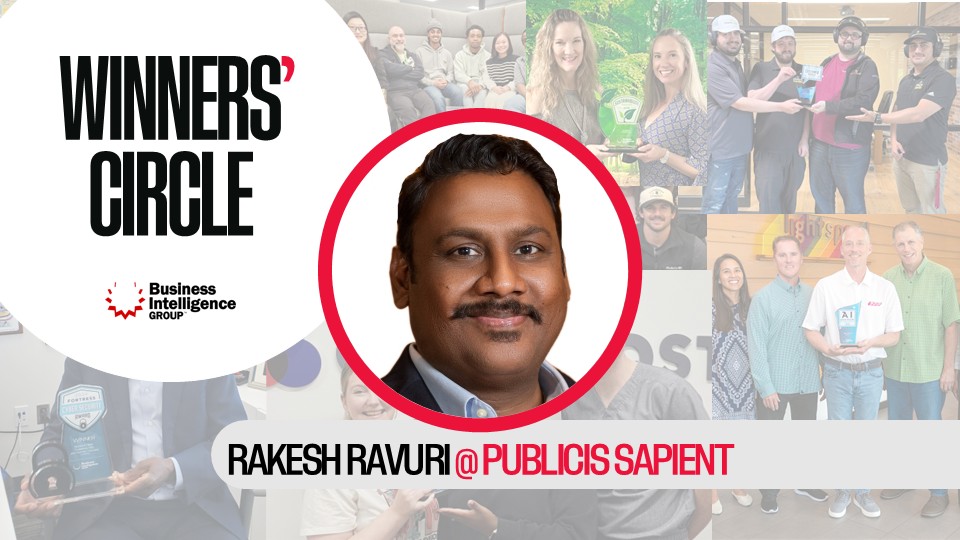
That is exactly the problem <a href="https://in.linkedin.com/in/rakeshravuri">Rakesh Ravuri</a>, CTO of <a href="https://www.publicissapient.com/">Publicis Sapient</a>, and his team set out to solve with Sapient Slingshot, and it is a big part of why they just won the 2026 AI Excellence Award. When I sat down with him for The Winners' Circle, what struck me was not just the technology, which is genuinely impressive, but the very specific philosophy behind it. This is not another coding copilot trying to shave a few minutes off your sprint. This is, as Rakesh puts it, the GPS for legacy code modernization.
From Internal Side Project to Enterprise Platform
Here is a fun detail that almost always gets lost in the marketing. Sapient Slingshot did not start as a product. It actually started back in March of 2023, right after the whole ChatGPT moment went mainstream. Rakesh and his team at Publicis Sapient wanted to give their consultants safe access to that kind of capability, but they obviously could not just let people paste client data into a public tool. So they built something internal called PSChat, got the right indemnity language in place with OpenAI, and released it to employees.
Almost immediately, people started building stuff on top of it. Someone shipped a Visual Studio plugin in April 2023, which, if you think about it, was really before Cursor, before Claude Code, before most of the tools we now think of as the standard. The team noticed a pattern. Developers were bouncing between the chat tool and their IDE, copying and pasting snippets back and forth, and somebody basically said, well why are we doing that manually. That insight is the seed of what became Slingshot.
Then a client walked in with millions of lines of COBOL and asked if Publicis Sapient could help. According to <a href="https://www.reuters.com/article/us-usa-banks-cobol/banks-scramble-to-fix-old-systems-as-it-cowboys-ride-into-sunset-idUSKCN0X10OE">Reuters reporting cited by BMC</a>, there are roughly 220 billion lines of COBOL still running in production globally, and an estimated 43 percent of banking systems and 95 percent of ATM swipes rely on it. That is not a fringe problem, that is the backbone of modern finance. The client did not just want a translation, they wanted to understand what their own system was doing so they could layer AI features on top of it. That request is basically what kicked Slingshot into existence as a real platform.
Why Everyone Else Gets It Wrong
When Rakesh talks about why most AI modernization attempts fall apart, he keeps coming back to one word. Context. Every other tool in the market, and there are a lot of them, tries to do what he calls the brute force approach. They go from code to code directly, skip all the intermediate steps, and hope the AI figures it out. In theory that sounds elegant. In practice, it falls apart the moment the codebase gets interesting.
Slingshot instead goes code to specification, then specification to enhanced specification, then enhanced specification to new code. That extra loop in the middle is where a customer can actually say, hey, while you are at it, can you also add this new capability. It is the difference between photocopying a blueprint and actually redesigning the building. And because Publicis Sapient took a first principles approach, mapping out exactly what a COBOL expert would do and then introducing AI only at the right moments, the output quality kept winning POC bake offs against the brute force competitors. This is the kind of approach <a href="https://www.moderne.ai/blog/gartner-application-innovation-business-summit-2025-recap">Gartner analysts highlighted at the 2025 Application Innovation Summit</a>, where they specifically warned against relying on AI alone due to its nondeterministic outcomes and recommended hybrid tooling where structured rules drive the actual changes.
The other place most tools break is the context window itself. In early 2023, models had about 4,000 tokens to work with. A single COBOL program could easily be ten times that. So the team wrote parsers that broke code into semantically coherent chunks, never in the middle of a function, and then built a layer to stitch the chunks back into a coherent map. Rakesh admits they did not even know they were building what the industry would later call a context layer. They were just trying to solve a real problem.
The Enterprise Context Graph, Explained Without the Jargon
Okay so here is where it gets interesting, and honestly a little bit philosophical. Rakesh argues that the AI world is deeply siloed. Coders have their IDE plugins, product managers have their Jira AI, designers have Figma tools, strategy folks live in ChatGPT. Everybody is generating their own context over and over, and nobody is tying any of it together.
Think about it this way. A product manager says, hey, we need a Google Pay button on the checkout page, because our Gen Z research shows they prefer it over credit cards. That context, the why, lives in the PM's head or maybe in a Jira ticket. By the time the developer picks up the story, they only see the what. The tester picks up even less. Production support picks up less still. Every handoff loses information. A good human team compensates with hallway conversations and tribal knowledge. AI, without that context, just guesses and hallucinates.
Slingshot is built on what Rakesh calls an enterprise context graph, which ties together the reasoning behind every phase of the software lifecycle. Publicis Sapient internally calls this SPEED, which is short for Strategy, Product, Engineering, Experience, and Data. The graph lets an AI agent working on any node pull in the history of decisions from everywhere else. It is the difference between an agent that knows your codebase and an agent that knows your company. And governance sits on top, so sensitive things like fraud detection algorithms can be referenced without being exposed.
Provenance, or Why Your Compliance Team Will Love This
This is the part that I think a lot of CIOs are not yet awake to. Slingshot has a patent pending feature called provenance. Every line of code produced by the system is tagged at the line level with who or what wrote it, which model was used, what context fed into it, and when it happened. If tomorrow a particular model turns out to have had a security flaw, you can literally pull up every line of code it ever generated and review it. Try doing that with your current setup, I will wait.
Rakesh makes a pretty sharp point here. Right now most enterprises cannot even tell you how much of their checked in code was AI generated, let alone which tool produced it. That is going to become a very uncomfortable conversation as regulators catch up. <a href="https://www.baytechconsulting.com/blog/enterprise-coding-ai-milestone-2025">A recent Veracode analysis of code generated by more than 100 large language models</a> found that roughly 45 percent of AI generated code samples contained insecure code that failed to meet basic security standards. Without provenance, you cannot even begin to triage that risk. He calls this principle explainable code over working code, which is his riff on the old agile mantra of working code over documentation. Documentation is cheap now. Explainability is the new scarce resource.
What This Means for CIOs Sitting on Technical Debt
If you are a CIO or engineering leader trying to figure out where to start, Rakesh's advice is refreshingly practical. Most companies have already run small AI experiments on their legacy code. The team has convinced themselves that yes, AI can explain this COBOL file. The real question is how to do it at scale, across millions of lines, without introducing a whole new kind of chaos. <a href="https://www.gartner.com/en/newsroom/press-releases/2024-04-11-gartner-says-75-percent-of-enterprise-software-engineers-will-use-ai-code-assistants-by-2028">Gartner predicts that 75 percent of enterprise software engineers will be using AI code assistants by 2028</a>, up from less than 10 percent in early 2023, so scale is coming whether you are ready or not.
Publicis Sapient typically starts with a POC that keeps one variable constant, usually the database layer, and runs the new code in parallel with the old system, comparing outputs. They actually have a patented technique called DBRE for this, which measures whether the business logic is truly preserved. And they still keep humans in the loop, just concentrated on the highest leverage verification work instead of line by line rewrites. As Rakesh puts it, you are not eliminating humans, you are scaling their value.
There is also the uncomfortable reality of AI technical debt. <a href="https://www.gartner.com/en/newsroom/press-releases/2025-11-19-gartner-identifies-critical-genai-blind-spots-that-cios-must-urgently-address0">Gartner predicts that by 2030, 50 percent of enterprises will face delayed AI upgrades or rising maintenance costs due to unmanaged generative AI technical debt</a>. The enterprises that win are going to be the ones that treated explainability, governance, and context as first class requirements from day one, not something to bolt on later.
Where This Goes Next
I asked Rakesh where he thinks this world heads in five years, and his answer went somewhere I did not expect. It is not just about sharing context, he says, it is about capturing behavior. Data warehouses already have the enterprise data. The next layer is behavioral. Why did the supply chain manager approve this order. Why did the architect reject this code review even though the tests passed. Right now that institutional knowledge leaves when people leave. An enterprise context graph that captures behavioral patterns could finally solve one of the oldest problems in business, which is that the best teams usually cannot explain why they are better than other teams. They just are.
It is a pretty compelling vision. And if Slingshot's first few years are any indication, Publicis Sapient has a real shot at building the platform that gets us there. Congratulations again to Rakesh and the whole team on the 2026 AI Excellence Award. It is well earned.
🎧 Want to hear the full conversation? Subscribe to The Winners' Circle on your favorite podcast player https://www.bintelligence.com/podcast.