






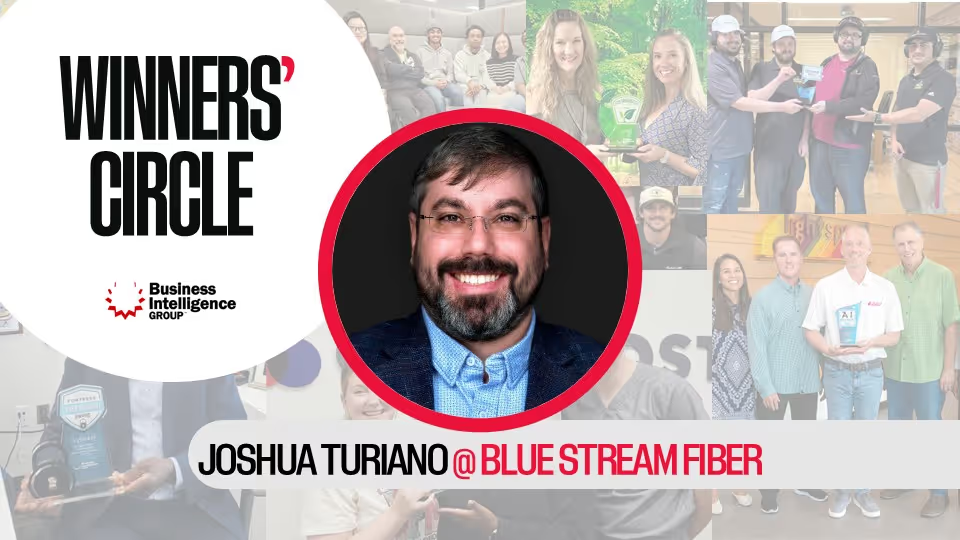

Joshua Turiano and his team at Blue Stream Fiber won our 2026 BIG Innovation Award, and honestly, I'm both impressed and a little jealous. They've done what so many telecom operators talk about but rarely execute on: they actually put AI to work in a way that makes everyone's life better.
Blue Stream operates as a multi-state MSO across Florida and Texas, serving HOAs, condo associations, and MDUs with the full suite of internet, TV, broadband, and home security services. It's the kind of complex multi-service environment that usually means 20 different systems and overwhelmed support staff. Joshua and his team decided to change that equation pretty dramatically.
Starting With Structure, Not Hype
Here's what really caught my attention. When ChatGPT became popular in 2024, Joshua didn't just throw AI at random problems. He realized something specific: if they could expose their structured data to AI implementation in telecommunications, the technology could basically revolutionize how their people got answers.
We're talking about CMTS data, fiber PON information, call notes, call summaries, and escalation details from HOA board members. All of that contextual nightmare, you know, the kind that takes forever to piece together when you're troubleshooting a network issue. Joshua saw an opportunity to make it instantly accessible.
The cool part? OpenAI told them they were the first company to show up with an actual plan. Most companies apparently just ask "how do we AI our business?" Blue Stream came in with mapped business processes and a clear vision: don't replace people, replace tasks.
The Support Guru That Actually Knows Everything
They built something they call the Support Guru. It's basically an AI interface that talks to their backend database, which they'd previously built as a CPE Dashboard. Anyone in the company can now ask it to analyze an account number, and in less than 10 seconds, it delivers a complete health report.
Light levels, FEC errors, bit error rates, call history, outage status, power failures. It can troubleshoot CMTS issues, analyze different frequencies, and explain why something's wrong while it's diagnosing the problem. You can literally just talk to it like a human.
The domain knowledge aspect is particularly powerful. Whether you've been at Blue Stream for two weeks or five years, you're now getting the same expert-level troubleshooting guidance. That's actually huge for training and consistency. Their call center KPIs went from five minutes down to two minutes for people using the system.
And here's the thing: it's optional. They don't force it on anyone. But obviously, people adopt it because it makes them look better at their jobs.
Field Techs Get Their Own AI Dispatcher
The field technician version is called the Field Tech Guide. It's similar but deeper and more structured because field work has different requirements. The team learned a valuable lesson during rollout though.
The initial training didn't account for how techs would interact with it day-to-day. The techs were treating it like an old-school bot, just typing "job 123456 start" with no context. The AI would get confused and ask for more information. The techs would get frustrated.
The fix was adjusting the training to explain that you have to talk to it like you're calling a human dispatcher. Give your tech number, job number, and what you need, just like you would in a real conversation. Once they adjusted the training and brought it closer to the techs' actual workflow, adoption improved. They're at about 30% adoption with field techs versus 90% in the support center.
{clip}
What Process Mapping Actually Means in Practice
Montana Tosca's backend development work was critical to the build. Joshua handled the AI side, and they tag-teamed the implementation incredibly quickly. They had an API ready in October 2024, launched a champions team that fall, and had a working model shortly after.
The key was having very strong business processes mapped before they started. They knew which tasks to automate or abolish. Their philosophy was simple: give front-line people more time to connect with customers, and the customer experience automatically improves.
This is where most telecom AI initiatives fail, honestly. Everyone wants the shiny AI solution, but very few companies have done the unglamorous work of actually mapping their processes and understanding which specific tasks eat up time without adding value.
What Customers Don't Know Won't Hurt Them (Yet)
Here's something interesting: Blue Stream's customers don't actually know they're interacting with AI yet. The company is testing the waters carefully. Recently, they put AI in front of certain call types. If you call in during an outage, the AI checks the status and tells you the expected restoration time. About 80% of people hang up satisfied once they hear that.
For routine billing questions, same thing. The AI handles it, and if you really want a human, you can still press the button. This is call containment done right, not the frustrating phone trees we all hate.
The pace of change is intense too. What they have now will look completely different in six months because the technology moves so fast.
Talking to AI Like It's a Toddler
Joshua has a great way of thinking about AI maturity: he trains people to talk to it like it's a toddler. Give it exactly what you want, and that's what you'll get back. Sometimes it might go "ooh shiny" and veer off, but it can only act on exactly what you tell it.
He's got four-year-old twins, so maybe that's why the analogy works so well for him. But the point stands: you have to be clinical in how you request things. AI can't get the context of your brain, and it doesn't understand sarcasm. That's probably not changing in the next 10 years, he thinks.
Alexa probably did us all a favor by training us how to phrase things structurally. "Play this from that in this room" taught us to work with databases, and that mental model translates directly to AI interactions.
The Mistakes Worth Learning From
The field tech rollout had a valuable learning moment. Joshua didn't spend enough time observing how techs actually work day-to-day. He mapped the process but didn't watch them use it in practice.
When he actually went out and looked at how they were chatting with the Field Tech Guide, he realized they were treating it like a legacy bot because the system was too structured. They needed it to feel more human and less rigid.
Sometimes process mapping doesn't mean people actually use the process as designed. You have to go observe, find those nuggets of wisdom in their daily work, and bring the tool closer to where they live mentally.
Why This Win Matters
Our BIG Innovation Awards increasingly focus on people and teams, not just products and companies. We do enough recognition for products. Let's do it for the humans actually doing the work.
Joshua's team at Blue Stream represents something I really appreciate: practical AI implementation that solves real problems and makes people better at their jobs. It's not about replacing anyone. It's about giving support staff and field techs superpowers through instant access to organized information.
The telecom industry is notoriously complex. Multiple systems, technical data, customer history, network health, vendor equipment, all of it has to come together when someone calls with a problem. Traditionally, that meant training, experience, and knowing which system to check next. Now it means asking an AI to pull it all together in seconds.
Blue Stream started in 2024 and already has measurable results. Two-minute troubleshooting versus five minutes. Ninety percent adoption in the support center. Real efficiency gains without forcing anyone's hand.
This is what AI implementation in telecommunications should look like: thoughtful, process-driven, human-centered, and genuinely useful. Congratulations to Joshua and the entire Blue Stream team on a well-deserved win.