




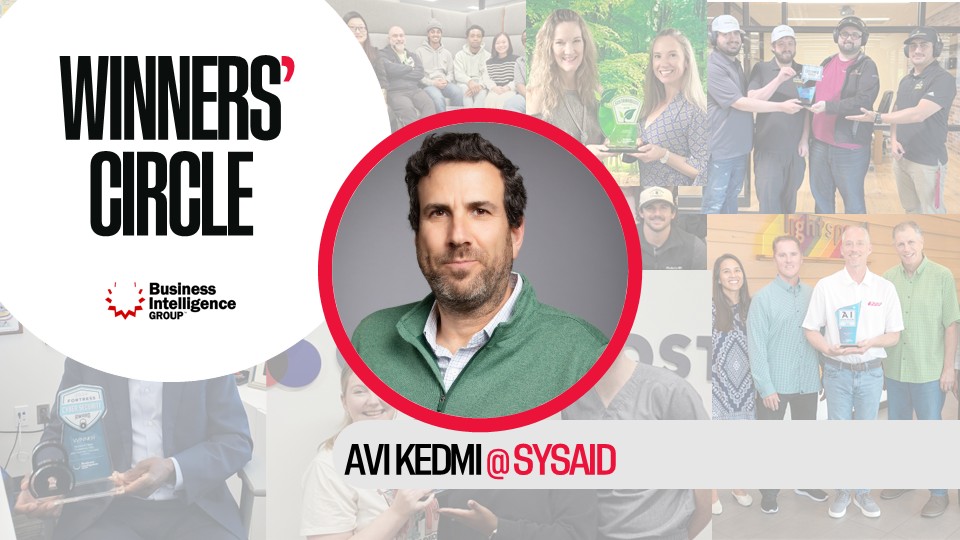

There’s a version of the AI transformation story that is basically a press release. Companies say they’re using AI, they gesture at some metrics, and everyone nods along. And then there’s the version Avi Kedmi told us, which is rather different. Kedmi is the CEO of SysAid, a 250-person IT service management platform operating in more than 100 countries, and the 2026 AI Excellence Award winner in the Software category. His version involves real numbers, a specific infrastructure philosophy, and a pretty honest look at what it actually takes to transform an organization from the inside out.
The headline metrics are, frankly, kind of jaw-dropping. SysAid’s CSAT jumped from 68 to 93. Detractors dropped 94 percent, from 17 a month down to one. Front-line resolution is now running at 77 percent, which is, by most benchmarks, well beyond industry norms. P1 incidents were cut in half. And escalations dropped sharply. So, naturally, the question is: how?
Two Infrastructure Strategies That Make Everything Else Possible
Kedmi is pretty clear that the transformation wasn’t about buying new software or running a flashy pilot. It was about getting the foundational architecture right first. He describes two core strategies that he thinks are, basically, table stakes for any company serious about becoming what he calls an “agentic organization.”
The first is a data lake that operates on a new philosophy. In the past, the goal was to bring in only the data you needed. The new strategy is to bring in the maximum amount of data you possibly can, and then surface it through something like an MCP layer. The idea is that whoever is running support, or any other function, should be able to understand what’s actually happening at any given moment without waiting for someone to build a pre-designed report.
The second strategy is API exposure across every system in the company. Kedmi puts it simply: anything you can do by clicking in an interface, you should also be able to trigger via an API. In the past, the tendency was to expose the minimum API surface. In an agentic world, you want to expose the maximum. When you have those two things in place, you can actually deploy use cases fast.
According to Gartner’s research on agentic AI, organizations that invest in broad data accessibility and open API architectures are significantly more likely to see measurable returns from AI deployment, precisely because smart people in the middle can move quickly rather than waiting on IT to build custom integrations.
What Agentic AI Customer Service Actually Looks Like in Practice
Kedmi gives a pretty vivid example of agentic AI customer service in action. Say you get three tickets over three days, all from different contacts at the same organization. Each one is in a different queue. In the old world, you might not even notice they’re related until someone escalates.
In SysAid’s new model, the system identifies the correlation automatically, reassigns all three tickets to a single support owner, notifies the customer success team, generates a summary brief, and sends a proactive email to the client offering a check-in call. That’s a mini-crisis handled before it becomes a big crisis, and it’s happening without a human manually connecting the dots.
The scale of what’s now possible is, apparently, the real unlock. In the past, building a workflow like that might have taken two weeks and required dedicated developer time. You could build maybe 10 of those, and then you just ran with the same 10 for five years. With the right underlying architecture, Kedmi says, you can actually build hundreds of these use cases. The constraint shifts from “can we build it” to “can we imagine it.”
The People Side of the Transformation
One of the things that stands out about SysAid’s story is that the transformation didn’t happen over the heads of the people doing the work. Kedmi is straightforward that the biggest credit goes to Asaf, their head of care and support, who led the operational change from the ground up. That kind of acknowledgment matters, because it points to something real about how the project was actually structured.
The philosophy Kedmi describes is not “AI replaces people.” It’s more like “AI lets the same person do 50 things a day instead of six.” He talks about building the transformation with people, not at them, and being deliberate about communication when roles shift. His team reportedly builds detailed decks and timelines for every organizational change, with FAQs, messaging guides, and manager briefings delivered in advance. Nobody, he says, should ever just disappear without a communication plan.
That kind of change management rigor is, honestly, a lot less common than the technology discussion. McKinsey’s research on AI-led transformation consistently shows that the human and organizational factors are the biggest predictor of whether AI programs actually stick, far more than the technology itself.
Three Fronts, One Vision
Kedmi frames SysAid’s current priorities around three areas. First, product: not just building AI into the platform, but actually driving real customer adoption of it, because he sees plenty of great tools that just sit unused. Second, the internal transformation: what does it actually mean to run an agentic organization, and how do you do it safely? Third, people: how do you help your team grow with AI rather than feel threatened by it?
He also has a longer view on where this is all heading. In three years, he thinks there will be far fewer tickets overall, not just because AI will handle them faster, but because AI will also write better code, produce fewer bugs, and reduce the root causes that generate tickets in the first place. Support organizations will get smaller in scope, but the work that remains will be more meaningful.
Kedmi wraps up with a reference to Tony Hsieh’s Zappos philosophy: stop measuring people by how fast they close calls, and start measuring by how much genuine care they extend to each customer. Even the AI SysAid builds, he says, is built with compassion in mind.
That’s a harder thing to automate than a ticket routing rule. And honestly, it’s the part that seems to have made the real difference.
Enjoying insights from industry leaders? Subscribe to The Winners’ Circle podcast on your favorite podcast player and never miss an episode. Listen and subscribe at bintelligence.com/podcast.