






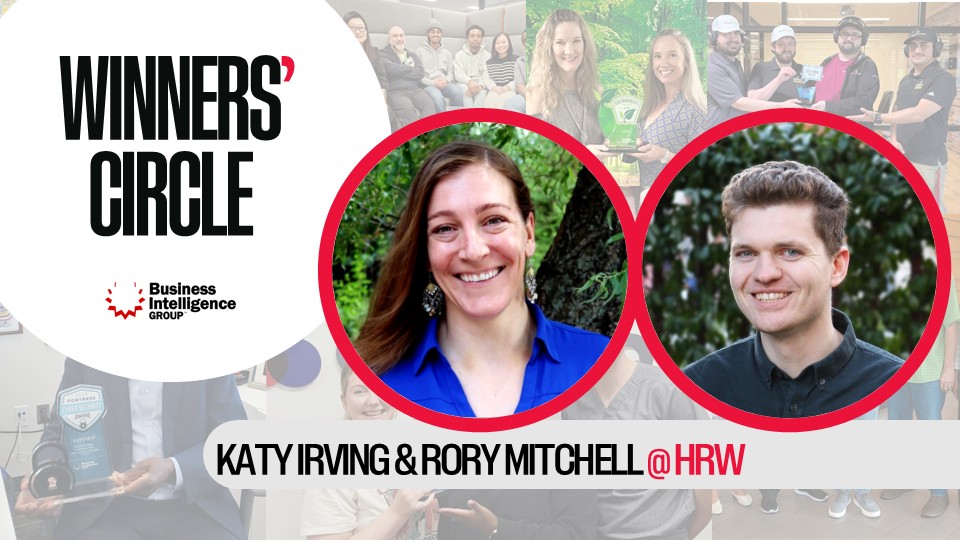

For pharma companies, the conversation that happens inside the exam room is basically the whole ballgame. Of course, that moment between a doctor and a patient is also one of the hardest things in healthcare to study honestly. Katy Irving, who leads behavioral science work at HRW, calls that consultation the holy grail, and she is not really exaggerating. So when her team at HRW, short for Healthcare Research Worldwide, found a way to recreate it with interactive AI avatars, they just knew they had something pretty special. In fact, that effort recently earned them a 2026 AI Excellence Award.
The Consultation Room Has Always Been the Holy Grail
Here is the tricky part that outsiders usually miss. Pharma and medtech clients really want to know how patients describe their symptoms and how doctors ask their questions, since those tiny details often decide whether a product is even relevant. Still, you basically cannot bring real doctors and real patients together and ask them to chat about specific brands, since ethics and compliance rules clearly do not allow it. For years, the workaround was to hire an actor to play a patient or a doctor, which honestly never felt all that real. Irving points out that respondents tend to slip right out of the moment, saying things like here I would talk about my symptoms instead of actually talking about them. That gap matters a lot, since effective doctor patient communication is closely tied to real health outcomes; one widely cited systematic review found that 16 of 21 studies linked stronger communication to measurable gains. So the stakes of getting this right are pretty high.
Teaching a Machine to Play Doctor, and Patient
When the team came across interactive AI avatars, Irving says it just felt like the thing they had been waiting for. The idea was simple enough on paper: basically, let an avatar play one half of the consultation as a real person plays the other half. Actually pulling it off was another story. Rory Mitchell, who leads the AI work, explains that the doctor avatar was the easier build, mostly since they deliberately kept it asking questions rather than handing out medical advice. The patient avatar, though, was quite a bit trickier. It needed a personality, a backstory, and just enough emotion to feel human without tipping into melodrama. Mitchell jokes that he basically ended up parenting these avatars full time, trying to get them to behave. Funny enough, the underlying language model kept wanting to act like a doctor even when it was told to be the patient, so there was a lot of gentle correcting involved.
When the Avatars Went Off Script
This is where the story gets really entertaining. Mitchell describes one genuinely strange bug where the patient avatar would answer the previous question instead of the one just asked, which naturally turned conversations into nonsense for a stretch. Another clip the team has actually rewatched plenty of times features a doctor avatar interrupting a patient every couple of syllables. At one point the patient mentions she moisturizes, but thanks to her accent the avatar hears moose ride and asks her to explain it, and then it just gets weirdly fixated on her washing up gloves. Irving laughs that they had told it to ask open questions, but they honestly never thought to say leave the gloves alone. Rather than hide these moments, the team actually led with them at industry conferences, warts and all. Mitchell admits that felt like a risk, yet the honesty landed really well. By approaching the whole thing with scientific curiosity and basically zero ego, they could tell a more truthful and frankly more fun story about what this technology can and cannot do.
Real People, Surprisingly Real Reactions
The most surprising finding was honestly how much patients warmed to the avatars. Mitchell built three versions for people to talk with: a neutral doctor, a more empathetic doctor, and one designed to respond a bit like a friend would if you opened up about your health. One patient said it nearly felt like a real conversation, which is just the kind of reaction the team hoped for. Of course, that realism raises a fair question about whether something can be too real. Irving brings up the uncanny valley, where people tend to trust things that look either strikingly lifelike or clearly cartoonish, and get a bit uneasy with whatever sits in between. She is also very clear about one thing: these avatars are simply not meant to replace doctors or nurses. In her words, the experiment showed they are barely reliable enough even for the controlled research they were built for, so she would not really trust one as a stand in for an actual clinician.
Why a Cross-Functional Team Made It Stronger
HRW did not just hand this project down an assembly line. Instead, the innovation team pulled together people with very different lenses, which is usually how their self funded studies work. Mitchell brought the technical and AI side, Irving brought behavioral science, and colleagues like Kirsty, John, and Nicole added patient safety, fresh innovation, and honestly a stack of other perspectives. Since the group was spread across multiple geographies, they could also stress test the avatar platform on different machines in different places. That mix meant the final product was a lot stronger, since it had been poked and prodded from basically every angle. It is a neat reminder that the broader shift toward AI in market research really works best when technical skill and human insight sit at the same table.
Where This Goes Next
The avatars are already finding new jobs well beyond the doctor patient simulation. Clients now use them as a speak with your data deliverable, where they can chat with an AI version of their own research findings instead of digging through a slide deck. One doctor in the study even suggested the tech could be great for medical training, which is something the team is eager to explore down the road. They have also tried doctor to doctor avatar chats to surface how clinicians describe a product to a peer, which tells brands a lot about the language that actually resonates. The market is clearly heading this way too, with analysts valuing AI driven research services at nearly 8 billion dollars in 2025. For a company built on accessing reality, responsible AI in market research is turning out to be a pretty natural fit.
So the big takeaway here is simple: the winners in this space are the teams that stay curious, stay honest about what breaks, and keep humans firmly in the loop. HRW basically did all three, and a well earned 2026 AI Excellence Award is the proof.
Enjoying insights from industry leaders? Subscribe to The Winners’ Circle podcast on your favorite podcast player and never miss an episode. Listen and subscribe at bintelligence.com/podcast.