




Pretty much every marketer, sales leader, or product owner has lived through the same frustrating loop. You finally get the team into a conference room, you actually walk them through the new tool with a polished deck, you check the box on the project plan, and then a week or so later somebody pings you asking how to do the very thing you just trained. Honestly, the training itself was never really the problem. The problem is that knowing something and being able to actually do it inside a live workflow are basically two different skills, and traditional learning programs almost always optimize for the first one and quietly ignore the second.
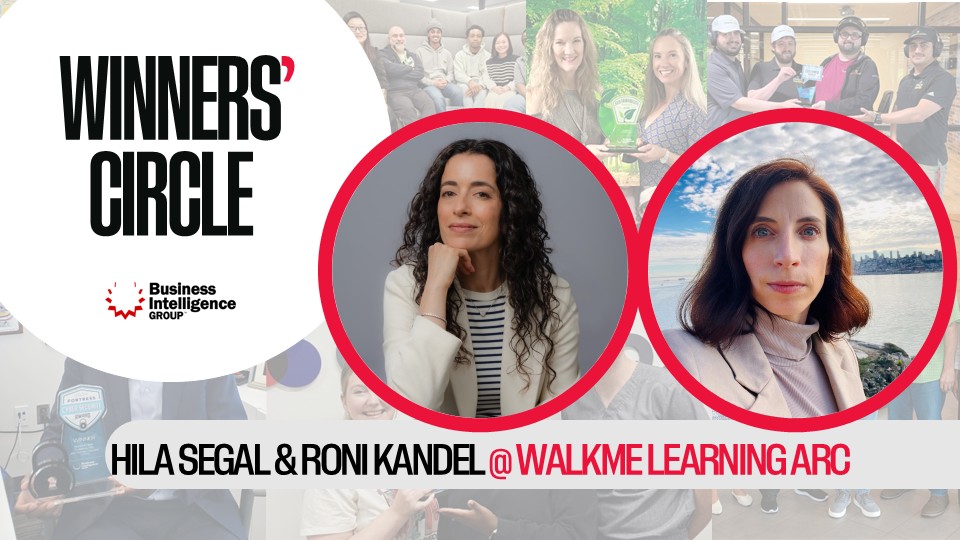
That gap is exactly what Hila Segal and Roni Kandel are charging at with WalkMe Learning Arc, a recent addition to the digital adoption category that they helped pioneer. WalkMe has spent more than a decade serving roughly 1,600 enterprise customers, including about 27 percent of the Fortune 500, by guiding employees through complex software in real time. Now the team is taking that same in-app intelligence and bolting on something L&D leaders have basically been begging for: training content that shows up at the exact moment a worker needs it, in the tool where the work actually happens.
Why The Knowing Doing Gap Has Been So Stubborn
This is, frankly, a really old problem. Most enterprises have, for ages, had two completely separate disciplines pointed at the same employee. On one side you have L&D pros designing courses, building modules, and tracking completions. On the other side you have IT and software owners deploying the actual applications people use to do their jobs. There usually is not, or has not been, a clean handoff between the two.
Segal and Kandel argue that the pace of change has, more or less, broken the old model. New tools and updates land weekly, sales methodologies shift quarterly, and ERP rollouts touch entire workforces at once. Industry analysts back this up: a recent Gartner forecast projected that 30 percent of generative AI projects will be abandoned after proof of concept by the end of 2025, often because the people meant to use them are not really equipped to operate them confidently. Kandel sums up the new opportunity simply: “We’re inventing a new era or a new set of skills and responsibilities and empowering L&D leaders to take bigger ownership and bigger control on how learning is actually being done.”
What In The Flow Of Work Actually Means
The phrase “in the flow of work” gets thrown around a lot in HR tech, so it is fair to ask what it really means inside a product like Learning Arc. Basically, WalkMe already has a deep, screen-level understanding of what an employee is doing inside any given application. Learning Arc layers on top of that signal, surfacing the right module at the right moment, like just before a sales rep moves an opportunity through a sensitive stage, or right when an HR specialist is about to touch a regulated process for the first time.
Segal points to a real internal example. WalkMe rolled out an AI literacy course inside Learning Arc, and the team set it up so that an employee about to open a tool like Claude or Gemini for the first time gets a nudge, a reminder, or, in some cases, a full block until the course is finished. So the learning is not really a separate event anymore. It is just kind of woven into the workflow itself, which is honestly how humans tend to actually retain information.
Solving The Personalization And Scale Tension
Marketers reading this are probably nodding along, because the same tradeoff has plagued personalization in every channel. As a matter of fact, the more personal you try to get, the worse and less accurate things tend to get at scale. According to a McKinsey analysis, 71 percent of consumers expect personalized interactions, and yet most companies still struggle to deliver them consistently across touchpoints. Learning has historically had the same issue, just hidden inside the L&D function.
Kandel and Segal’s answer leans on two ideas working together. First, real human oversight stays in the loop, with controls that let authors fine tune the outline, the simulations, the quizzes, and even constrain which sources the AI is allowed to pull from. Second, learners get format flexibility. If a video is too granular, you can switch to a text mode. If you would rather listen to it on the way to a meeting, audio is right there. As Kandel puts it, “We all learn differently. We have different preferences,” and the platform stops forcing the old, one-size-fits-nobody choice between fast and engaging.
Why L And D Teams Are Actually Trusting The AI This Time
L&D buyers are, rightfully, a skeptical bunch. They have seen plenty of vendors slap an AI label on tired tools. So Kandel and the team made transparency the default. Every piece of AI generated content shows its work: which assets it pulled from, how closely the output is grounded in the source material the customer provided, and where a human can step in and adjust. That visibility is what is actually winning trust, more than any benchmark or demo.
The early signal is that the speed-up is real. Kandel says the most common first reaction from L&D leaders is, basically, “This would have taken me months and we just did it in a few minutes.” That kind of velocity matters because, according to a Deloitte Global Human Capital Trends report, employees are increasingly expecting on-demand growth opportunities, while organizations struggle to scale traditional L&D programs to match. Tools like Learning Arc are basically letting smaller L&D teams punch way above their weight.
What This Signals For Enterprise Software In General
Zoom out a little and Learning Arc is also kind of a signal about where enterprise software is headed in general. Segal and Kandel both expect the next few years to bring extreme velocity, with rapid iteration across product, design, and go-to-market. Roles will start to merge, with product people doing more development work and developers thinking more like product managers. The winners, they argue, will be the teams that turn that speed into actual user value rather than just a flood of barely usable features.
For directors of marketing and PR account leads, the takeaway is fairly direct. The companies that are going to dominate the next cycle are the ones helping their customers and their own employees absorb constant change without burning out. AI native learning is one of the most underrated tools for doing that, because it quietly compounds inside every other workflow. Treat it like infrastructure, not like a one-time training initiative, and the results tend to follow.
Enjoying insights from industry leaders? Subscribe to The Winners’ Circle podcast on your favorite podcast player and never miss an episode. Listen and subscribe at bintelligence.com/podcast.