





Employee surveys have always been powerful tools for understanding company culture. Until recently, though, they were also maddeningly difficult to use effectively. The Best Places to Work Awards are changing that equation by combining rigorous, research-backed surveys with modern AI that turns thousands of employee responses into clear, actionable insights in hours instead of weeks.
Beyond the Badge: What You're Really Getting
When your organization participates in the Best Places to Work Awards, you're not just competing for recognition. You're inviting your employees to tell the unfiltered truth about their experience: how satisfied they are, whether they'd recommend the company, how they feel about pay, communication, leadership, and growth opportunities.
The resulting dataset is incredibly rich. In a typical program, thousands of employees across job levels, tenure bands, and demographic groups answer more than twenty detailed questions about their day-to-day reality. For a CEO or CHRO, this is a full diagnostic of organizational health.
The Old Way: Drowning in Data
Historically, the hard part started after the survey closed. HR teams exported giant CSV files, built complex pivot tables, and manually created charts trying to make sense of trends by level, location, or tenure. By the time the numbers were ready to share, the energy and curiosity that surrounded the survey had faded. Leaders glanced at a summary, nodded at a few high-level percentages, and moved on to the next fire.
The potential of the data stayed largely untapped.
The AI Difference: Minutes, Not Weeks
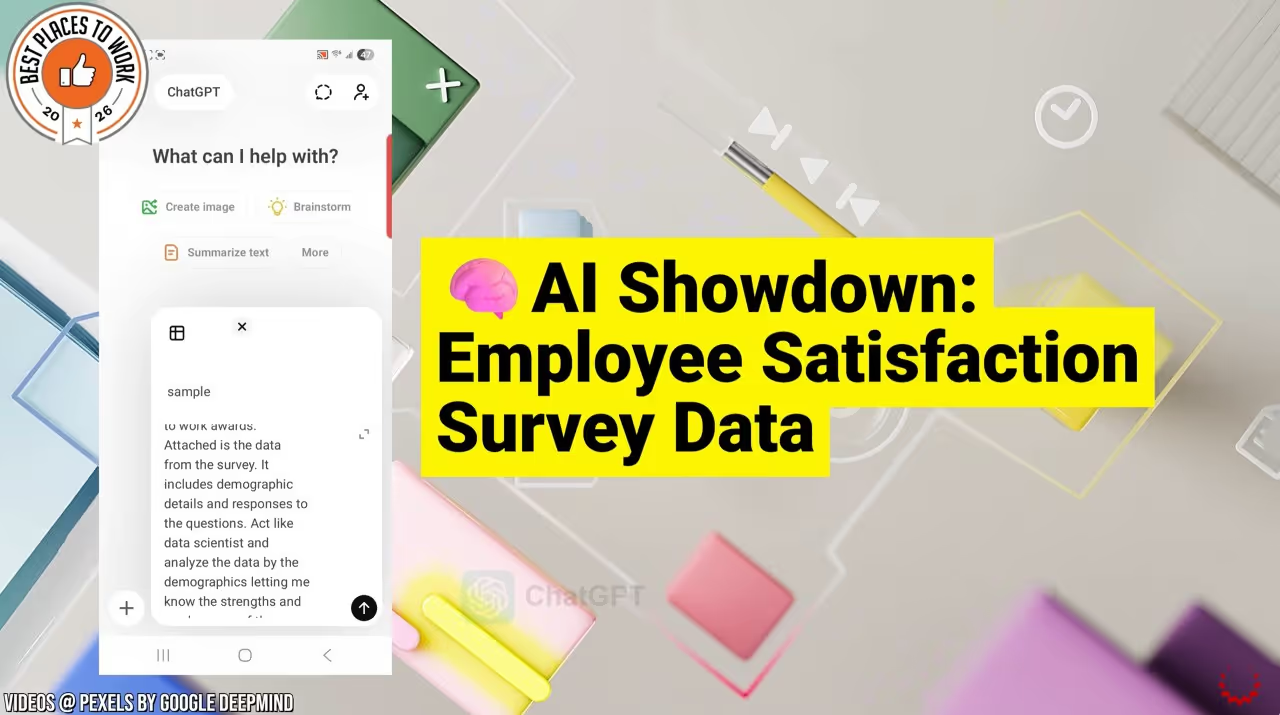
AI has completely changed that timeline. With the same raw file generated for the Best Places to Work survey, AI can now do in minutes what used to take weeks.
Structured questions - overall satisfaction, likelihood to recommend the employer, perceived salary competitiveness, sense of being respected, understanding of company mission - can be cleaned, grouped, and analyzed automatically. AI instantly calculates averages and Net Promoter-style scores, then highlights where scores are strongest and where they slip, all broken down by job level and years of service.
Leaders can see at a glance if their Directors are thriving while mid-career employees feel stuck, or if new hires are excited but long-tenured employees are quietly disengaging.
Seeing the Shape of the Data
AI surfaces the shape of the data, not just the averages. Instead of a flat "7.7 out of 10," leadership sees how many people are true promoters (rating 9-10) and how many are detractors (rating 1-3) on critical questions like "Would you recommend this company to a friend looking for a job?"
This polarization analysis tells a richer story about loyalty and risk. One Best Places to Work dataset showed more than half of employees rating employer recommendation a 9 or 10 - but also more than one in ten rating it 3 or below. That vocal minority was deeply unhappy. Seeing both realities side by side changes the conversation in the executive room.
Turning Comments Into Insights
The magic becomes even more obvious when AI processes unstructured comments. In many surveys, thousands of employees answer open-ended questions like "What do you like best about working here?" and "Do you have any concerns you would like to raise?"
Reading every comment manually is nearly impossible. Historically, only a small portion of this qualitative gold reached leadership.
AI can now read and categorize all of it, clustering comments into themes: compensation, communication, recognition, leadership behavior, workload, flexibility, career growth. It surfaces the most common themes, notes where they're rising or falling compared with prior years, and extracts anonymized, representative phrases that bring the numbers to life.
The New Process: Survey to Strategy in One Afternoon
Organizations that once treated the awards survey as a one-time compliance task can now treat it as the centerpiece of their annual culture and people strategy. The process looks less like a form and more like a full diagnostic:
- The organization nominates for Best Places to Work and fields the standardized employee survey
- As soon as the survey closes, the dataset is securely processed with AI
- Within hours, leadership receives a narrative summary, key charts and graphs, and a department-level action framework tailored to their data
Instead of waiting weeks for someone to "work the spreadsheet," executives walk into their next leadership meeting with clear visuals: satisfaction by job level, perception of pay and respect by tenure band, and the distribution of promoters versus detractors on core loyalty questions.
HR can see immediately where to prioritize compensation reviews, where communication is breaking down, and where managers are already doing an exceptional job developing their people. Operations and department heads get targeted action items instead of generic engagement advice.
The Double Win
For participating companies, the benefit is twofold.
First, the awards themselves matter. External recognition as a Best Place to Work supports employer brand, recruitment, and retention.
Second - and arguably even more valuable - the same data that powers the award application now powers a concrete, data-backed roadmap for improving the employee experience.
Organizations can compare results year over year, track whether changes in pay structures or communication rhythms are having the intended effect, and demonstrate to employees that their feedback is not only heard but acted on.
The Bottom Line
If you're already investing the time to participate in the Best Places to Work Awards, you're sitting on one of the richest data assets you'll collect all year. Thanks to AI, unlocking that asset is no longer a multi-week analytics project reserved for specialists.
It's an accessible, repeatable process that any participating organization can use to move from survey to strategy in a single afternoon - turning recognition into real, measurable progress for their people.
Ready to transform your employee feedback into action? Learn more about the Best Places to Work Awards and how AI-powered insights can help you build a better workplace: https://www.bintelligence.com/awards/best-places-to-work