





There is a graveyard of restaurant robotics startups out there. Companies that raised hundreds of millions of dollars, hit the cover of trade magazines, and then quietly disappeared. The early days of food automation were, as <a href="https://www.linkedin.com/in/richardhull/">Rich Hull</a>, CEO of <a href="https://misorobotics.com/">Miso Robotics</a> put it to me, all about novelty. "Robots in my restaurant, that's cool." Operators bought one, got the press hit, and then realized the thing did not really work at lunch rush. Whole companies died on that.
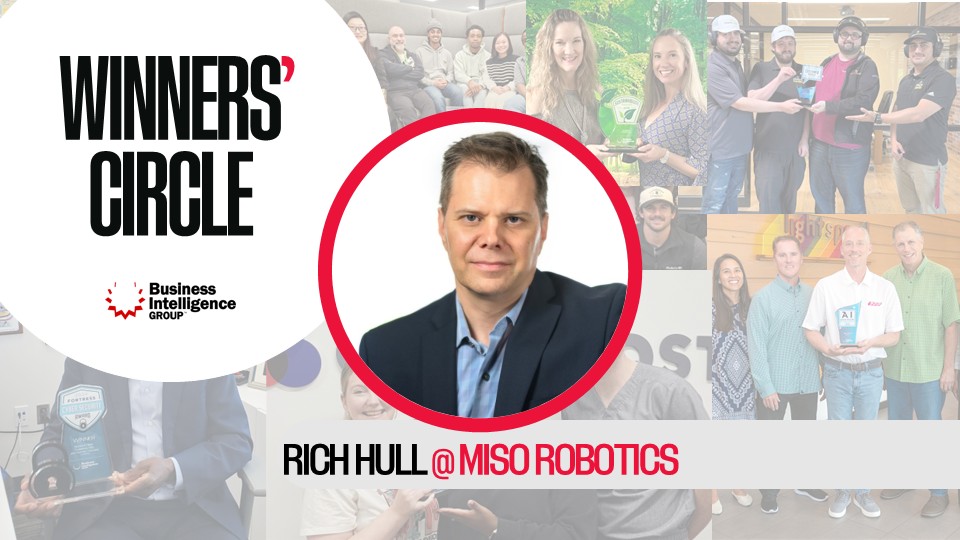
Miso did not. Today, the third generation of their flagship product Flippy is half the size of the previous version, twice as fast, and installs overnight in a few hours. It is running fry stations at White Castle and other major chains. And it just won the 2026 AI Excellence Award. I sat down with Rich to talk about how Miso made it through the first wave, what the second wave actually looks like, and where this whole space is heading. Quick background on Rich. He is a former film producer who was a founder of the VIX streaming service, the largest Spanish language streaming service in the world, sold it to TelevisaUnivision, and then got recruited into Miso by his partners at Ecolab, the Fortune 100 cleaning solutions company that has been around for a hundred years. Not a typical robotics CEO path. As you will see, that is part of the point.
The First Wave Was About Novelty. The Second Wave Is About ROI.
Rich made an analogy that stuck with me. "Does anybody remember MySpace? Probably not. Facebook won that. Does anybody remember Palm Pilot? Probably not, the iPad won. Miso is the first mover in the second wave." That framing is helpful because it reorders how you think about the entire category. The first wave of food robotics was a science experiment. Operators took meetings because the technology was cool, but cool does not survive a Tuesday lunch rush. The companies that died were almost all victims of the same problem. The product worked in a controlled demo. It did not work consistently in a real kitchen.
Rich gave a presentation at a Citibank conference earlier this year where his entire thesis fit on a tattoo. "It just has to work." Someone in the audience pulled him aside afterward and told him that should be inked on his forehead, and Rich agreed. Reliability is the table stakes. Beyond that, today's operators want measurable ROI, and they want it fast. Flippy delivers a 3x return on every dollar spent. Miso's other product, Zippy, an employee revenue engine, delivers 10 to 15x. <a href="https://dataintelo.com/report/restaurant-robotics-market">According to industry analysis, robotic kitchen systems are now delivering payback periods of 18 to 36 months for high-volume QSR operators</a>, a threshold that finally makes the investment case work for mid-sized chains too, not just the giants who can afford to experiment.
Why the Labor Crisis Made Robotics Inevitable
The numbers in restaurants right now are sobering. <a href="https://www.restroworks.com/blog/restaurant-turnover-statistics/">QSR turnover rates exceed 130 percent annually, meaning the average position cycles more than once per year</a>, and Cornell's Center for Hospitality Research pegs the average cost of replacing a single front-line restaurant employee at $5,864. Multiply that across a chain with thousands of stores and you start to understand why Rich talks about this as a structural problem, not a cyclical one. He pointed out that birth rates in the US have declined every year for the last 20 years. There are simply fewer teenagers available to fill these jobs, and the ones who are available do not particularly want them. <a href="https://news.ucsc.edu/2026/03/exploring-impacts-california-minimum-wage-fast-food-workers/">California's $20 per hour fast food minimum wage that took effect in April 2024 has compounded the math</a>, and similar moves are being discussed in Los Angeles, New York, and elsewhere. There have been more restaurant bankruptcies in the last 12 months than in the prior five years combined.
Then Rich told me a story that made the whole picture click. Last summer, Miso opened a pop-up restaurant called Cali Express by Flippy in a vacant space across the street from their Los Angeles office. A week before opening, they posted a job listing for kitchen workers. They got zero applications. Literally zero. So they rewrote the listing to say "you get to work with a robot at the fry station." In 24 hours, they had 200 applications. That is not a small story. That is the entire labor problem in microcosm. The candidates exist. They just want a job that does not feel like a dead end. Working with a robot is something they can put on a resume. It says "I have digital experience, I understand AI." That is a recruiting unlock that no wage increase alone can match.
Reimagining the Workflow
The most surprising thing operators tell Rich after they install Flippy is not what you might expect. It is not the speed or the consistency. It is the reaction once the new workflow takes shape. "How did I live without this?" Because the fry station is no longer a bottleneck, the entire kitchen rhythm changes. Fries are typically the first thing that happens in a quick service order, so when fries come out fast, the whole conveyor belt downstream moves faster. Throughput goes up. The human who used to be tied to the fryer is now free to do upsells, talk to customers, or run other stations. Ecolab's independent study of Flippy in production found that human interaction with the fry station drops by almost 90 percent.
This is the part of the AI conversation that gets lost in the headlines. <a href="https://hostie.ai/resources/restaurant-tech-trends-q4-2025-voice-ai-new-front-door">41 percent of US restaurant operators plan to use AI for sales forecasting</a>, but the operational reality is that AI works best when it lets humans do the human stuff. Sweetgreen ran a robot called Spice in 20 stores. Their profit margin in those stores roughly doubled, going from 7 percent up into the 14 to 15 percent range. That is a public company reporting under SEC rules. You cannot fudge that. And it points to what Rich keeps insisting on. The math has to work. The reliability has to be there. And the humans who used to do the dangerous, hot, repetitive work get redeployed to the things humans are actually good at.
Predictive Cooking and the NVIDIA Partnership
Miso has been working closely with NVIDIA on the next layer, which Rich called predictive automation. Today's Flippy learns the traffic patterns of a specific restaurant and starts cooking before the order even reaches the point of sale system. Imagine that. The fries are already in the basket while the customer is still talking to the cashier. Because the fry station drives downstream speed, that one optimization compresses the entire order timeline. Miso is rolling that out with one customer in a pilot now and expanding to others soon. NVIDIA, Rich said, looked across the entire food industry landscape, picked Miso, and only Miso. Jensen Huang, NVIDIA's CEO, has called AI the biggest gold mine in history. That is the kind of partnership that does not happen by accident.
What Founders Should Hear
I asked Rich what advice he would give a founder building robotics. His answer was raw. "It's not how many good ideas you have, it's how many you make happen. Being a founder is insanity. Why anybody would do it is beyond me. But if you are wired like me, where you get up every day excited to solve big world problems, it is awesome." He has done it twice now, and is doing it again at Miso in a way. The thing he keeps coming back to is perseverance. Nobody is going to tell you that it is possible. You just have to believe it.
Congratulations again to Rich and the entire Miso Robotics team on the 2026 AI Excellence Award. The first wave is over. The second wave is here. And based on this conversation, I think Miso has a real shot at being the brand we all remember from this chapter, the way we remember Facebook from the social media era and the iPad from the mobile era.
🎧 Want to hear the full conversation? Subscribe to The Winners' Circle on your favorite podcast player: <a href="https://www.bintelligence.com/podcast">www.bintelligence.com/podcast</a>