







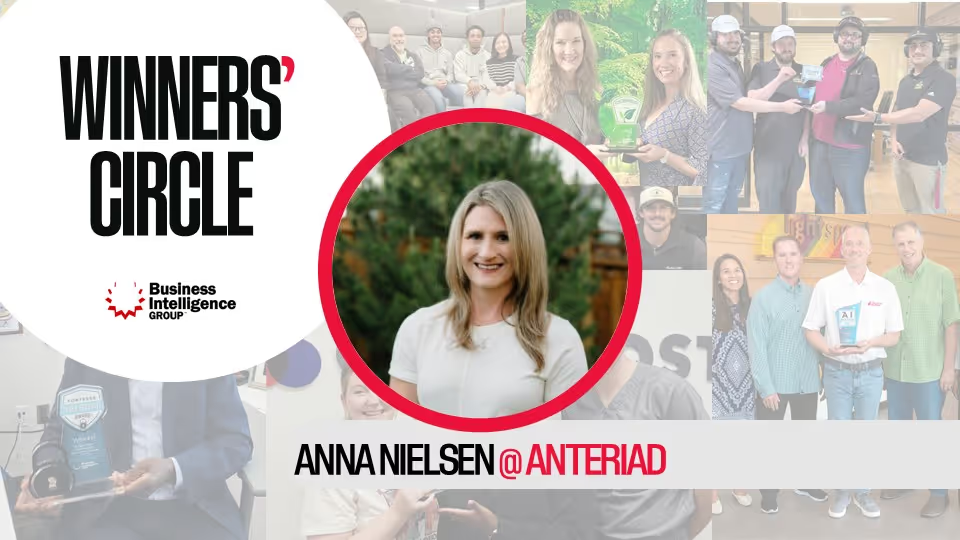

The buying committee has, it turns out, gotten really complicated. We're talking anywhere from five to upwards of 15 people who can actually influence or make the decision to purchase a product in B2B environments these days. Anna Nielsen, VP of Product at Anteriad, processes this reality through approximately 50 billion intent signals every single week, and she's basically figured out how to make sense of all that noise in ways that actually help marketers reach the right people at the right time.
Nielsen leads strategy and execution for the Anteriad Marketing Cloud Platform, and her team just won both a Stratus Award for Cloud Computing and a SAMMY Award for Sales and Marketing Excellence. The recognition, very much, comes from solving a problem that marketers have talked about for years but struggled to actually execute on, which is account-based marketing that goes beyond theory into practice.
The Buying Group Reality
Account-based marketing isn't exactly a new concept. Marketers have known for quite a while that they should be marketing to accounts rather than just individual contacts. But there's this layer of complexity that really changes everything, which is the buying group itself. You're not just marketing to Coca-Cola as an account, you're marketing to specific people at Coca-Cola who actually influence purchase decisions.
And those groups are getting bigger and more complex. Nielsen has seen numbers all over the place, but the consensus is basically that modern B2B purchases involve way more stakeholders than they used to. A technology purchase that might have been one person's decision ten years ago now requires buy-in from IT, security, finance, operations, and the business unit that will actually use the solution.
The challenge, as Nielsen explains it, is that marketers actually know they should be doing this. The concept exists, they understand it intellectually. But the execution is difficult and cumbersome and too much of an uphill battle to really get to. So they don't. They fall back on easier approaches even though they know those approaches are less effective.
This is where technology and AI come in, not as hype but as actual enablers. The technology exists now to identify who those individuals are in a given account and how to reach them. More importantly, it can help determine when to reach them with what message. That's the piece that makes buying group marketing actually practical rather than just aspirational.
Processing 50 Billion Intent Signals Weekly
Let's pause on that number for a second. Fifty billion intent signals processed every week. That's not total signals in existence, that's what Anteriad is actually processing through their specialized B2B intent feed. And that number is growing as more data becomes available and as more digital touchpoints generate trackable signals.
An intent signal is basically any digital behavior that indicates someone might be in market for something. Searching for specific topics. Downloading particular content. Visiting certain websites. Engaging with specific types of ads. Each signal individually doesn't mean much. But when you layer thousands of signals together and apply pattern recognition, you start to see buying intent emerge.
Anteriad layers this intent data onto rich firmographic information to tell customers who is in market and who is likely making a purchase decision. This helps marketers prioritize accounts so they're not spending time and money on accounts that aren't ready. Because here's the thing, if a buying cycle is 18 months long, you really don't want to be running expensive campaigns in month two.
According to research on B2B buyer behavior, buyers are typically 70% through their decision process before they even engage with a vendor. That means most of your opportunity to influence happens before anyone talks to sales. Intent data helps you identify when accounts are in that crucial early research phase.
This is actually better for everyone involved. As a consumer on the receiving end, you're not getting annoyed with messages, calls, contact points, and ads when you're not in market. If you don't have budget, you're truly not in market. Maybe you're getting there and building a strategy, but that requires a different message than the intense sales push that comes when budget is allocated and decisions are imminent.
The Full-Cycle Platform Approach
What makes Anteriad kind of unique is that they've connected all the dots from the entire lifecycle. You can identify prospects through intent data, activate audiences across major media platforms, orchestrate campaigns across channels, generate and qualify leads, and then report on everything at an account level. And they do this not just with tools but with people.
Some customers come to Anteriad and say, "Here's the data, here's the audience, we'll run the campaign ourselves." They have internal teams that know how to orchestrate campaigns across marketing channels. Other customers say, "You know what, do it for us." Generate leads, qualify them, handle programmatic advertising, manage the whole thing.
The Anteriad Marketing Cloud Platform orchestrates all of this and gives customers a window into that orchestration. Then on the back end, reporting shows an account-level view of engagements across all different channels. This matters because hitting the director of sales with three programmatic ads doesn't really mean anything if you didn't also hit someone else on their team with an email or a different touchpoint.
Nielsen's approach to reporting is actually pretty interesting. The report shouldn't be pulled on a campaign-by-campaign basis. It needs to give insight into all marketing activities because B2B buying is never about a single touchpoint. It's about cumulative exposure and building awareness across the buying group.
Anteriad claims a 100% reduction in reporting turnaround times, which is kind of remarkable when you consider that reporting used to be someone's entire job. Usually at month-end, that poor person would be like the tax collector, everybody needing reports immediately. By putting reporting first in the platform design rather than treating it as an afterthought, Nielsen's team basically eliminated that bottleneck.
The AI Applications That Actually Matter
Everyone's talking about AI right now, so the question becomes where does AI actually move the needle versus where is it just hype? Nielsen is thinking about this pretty carefully as she plans the product roadmap.
One area where AI makes real sense is workflow optimization, both internally for managed service teams and for customers. Campaign execution is full of repetitive decisions that AI can handle faster and more consistently than humans. Not replacing strategic thinking, but handling the tactical execution details.
Another area is identifying the right people at accounts. How do you know whether to target a Director of Marketing versus a VP of Marketing versus the CMO at a specific account? Which one is actually the decision maker? AI can learn patterns across thousands of similar accounts to make intelligent predictions about who to reach at new target accounts.
The next frontier, according to Nielsen, is determining the right message for each person. Truly personalizing marketing to a greater degree than has ever been possible. Personalization engines have existed for a while, she notes. She remembers platforms that could take a programmatic ad and tailor it based on location or metadata. AI takes that to another level.
Using AI to select the right piece of content from a library and match it to the right person is basically where this is heading. Not generic personalization like inserting a first name, but actual content that resonates with that specific person's role, challenges, and stage in the buying journey. That's the kind of personalization that actually drives engagement.
Nielsen is careful to distinguish between AI applications that make sense and move metrics versus areas that are just AI hype. The discipline to ask "does this actually help or are we just saying we use AI" is really valuable as every vendor claims AI capabilities.
The Shift From CRM to ABM Thinking
For anyone who's been out of the marketing world for a while, the terminology has shifted pretty significantly. CRM (Customer Relationship Management) used to be the dominant framework, basically a database of contacts that everyone interacted with. The focus was on individual people and tracking your relationships with them.
ABM (Account-Based Marketing) represents a different mindset. You're trying to get into Coca-Cola, and there are lots of ways to get into Coca-Cola. Locally, nationally, through partners. Multiple entry points, multiple stakeholders, multiple decision makers. ABM tracks engagement across the entire account rather than just individual contacts.
This shift reflects the reality that B2B purchases are rarely individual decisions anymore. The days of one champion making a purchase decision are pretty much over. Now you need buy-in from multiple functions, multiple levels, sometimes multiple geographies. Your marketing needs to reflect that complexity.
Nielsen sees the buying group concept as the next evolution beyond basic ABM. You're marketing to people at an account, specific individuals with specific roles and concerns. The CMO cares about different things than the CTO, who cares about different things than the CFO. Your messaging needs to address each person's perspective.
The Data Quality Foundation
All of this sophisticated targeting and personalization sits on top of data quality. Nielsen emphasizes that customers really come to Anteriad for the quality of data backing up campaigns. Intent signals are only valuable if they're accurate. Firmographic data only helps if it's current and correct.
B2B data gets messy fast. People change jobs. Companies get acquired. Organizational structures shift. Contact information becomes outdated. Maintaining clean, accurate data at scale requires significant ongoing effort and investment. It's not glamorous work but it's absolutely foundational to everything else.
The specialized B2B focus matters here too. Consumer data and B2B data are fundamentally different animals. Consumer behavior signals don't translate directly to business purchase intent. The patterns are different, the buying cycles are different, the decision processes are different. A platform built for B2B from the ground up will perform better than one adapted from consumer marketing.
Targeting in the Hybrid Work Era
One challenge that's emerged recently is how to target the right person when everyone's working from home or in hybrid arrangements. In the office, IP-based targeting could reliably identify someone at a specific company. At home, that gets complicated fast.
Nielsen tells a funny story about IP addresses in concentrated neighborhoods rotating, so your neighbor searches for something and you start getting ads for it. The kayak example is actually kind of perfect. Dad searches for a kayak, everyone in the household starts seeing kayak ads. But it goes beyond the household, in some neighborhoods you might start seeing ads based on what your neighbor searched for.
The solution involves triangulating multiple data points to accurately identify and target the right person. What business do you work for? What's your role? What content have you engaged with? Where are your digital footprints appearing? Layering these signals together lets you target the person and not their spouse, not their three-year-old on a tablet.
The kayak example is actually not terrible for household purchases because buying influence matters there too. The spouse might have input on a kayak purchase. The kids might say "Hey dad, I want a kayak." For some household purchases there's genuinely a buying group or buying committee. But for B2B purchases, you really need precision.
Why This Matters for Customer Experience
There's actually a customer experience argument for better targeting that doesn't get made often enough. When marketing is poorly targeted, it creates a bad experience for everyone. Recipients get irrelevant messages that annoy them. Marketers waste budget on unqualified audiences. Sales teams get poor leads that waste their time.
Better targeting through intent data and AI makes the entire system work better. You reach people when they're actually interested. Your messages are relevant to where they are in the buying journey. You're not pestering people who have no budget or authority. The experience feels helpful rather than intrusive.
This is the vision Nielsen is building toward. Marketing that's intelligent enough to be useful. Personalization that's based on genuine understanding rather than just mail-merge fields. Engagement that respects people's time and attention. It's a pretty different approach than the spray-and-pray mentality that dominated marketing for so long.
The Validation of Awards and Customer Success
Nielsen notes that winning awards is really validation that what they're doing matters to customers and makes a difference. At the end of the day, customers need to find value. The awards are nice, but the real measure is whether the platform helps marketers achieve their goals.
The Stratus Award for Cloud Computing and the SAMMY Award for Sales and Marketing recognize different aspects of what Anteriad has built. The cloud computing award acknowledges the technical infrastructure required to process billions of signals and orchestrate complex campaigns. The sales and marketing award recognizes the business impact and results.
Both matter because modern martech platforms need to be both technically sophisticated and business-focused. The technology enables possibilities, but those possibilities only matter if they translate into better outcomes. More qualified leads, shorter sales cycles, higher conversion rates, better customer acquisition costs.
Nielsen and her team have worked hard for these wins. Building a platform that genuinely solves complex problems requires sustained effort across product, engineering, data science, and customer success. The recognition validates that effort and provides momentum for continuing innovation.
The Future of B2B Marketing Technology
Looking ahead, the trends Nielsen describes are likely to accelerate. Buying groups will keep getting larger and more complex. Intent signals will multiply as more business activity happens digitally. AI capabilities will continue advancing. The challenge for marketers will be making sense of all this complexity.
Platforms like Anteriad that can process massive amounts of data, identify meaningful patterns, and orchestrate sophisticated campaigns will become increasingly important. The alternative, trying to do all of this manually or with disconnected point solutions, just doesn't scale to meet the challenge.
The companies that succeed in B2B marketing will probably be those that embrace this complexity while maintaining focus on fundamentals. Understanding your ideal customer profile. Creating valuable content. Building genuine relationships. The technology amplifies and accelerates these efforts but doesn't replace them.
Nielsen's perspective is valuable because she comes at this from the product side. She's thinking about what actually works, what customers actually need, what technology can realistically deliver. That grounded approach, combined with willingness to push boundaries with AI and intent data, creates a really compelling vision for where B2B marketing is headed.
The acronym soup of ABM, CRM, and B2B marketing terms can be overwhelming, but underneath it all is a pretty simple idea. Find the right people. Reach them at the right time. Say something relevant. Make it easy for them to engage. Do that consistently across buying groups and you'll probably see results. Anteriad is just making it possible to do that at scale with intelligence that wasn't previously available.