








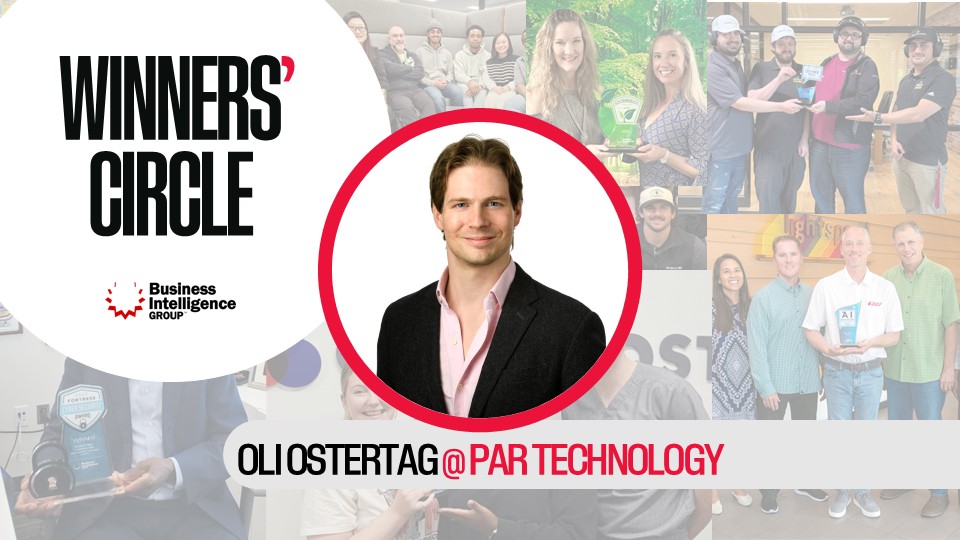

The quick serve restaurant industry is basically having an identity crisis with AI right now. Walk the floor of the National Restaurant Association show and apparently every booth is shouting the same two letters. The result is what Oli Ostertag, who leads product strategy at PAR Technology, calls AI fatigue, and frankly it is a real thing. Operators have heard the pitch so many times that they have just started tuning it out.
That skepticism is not, of course, paranoid. A recent MIT report on the state of AI in business found that the majority of enterprise AI pilots are still not delivering measurable ROI, which more or less validates what every restaurant operator already suspected. Yet PAR Technology, which just picked up a 2026 BIG Innovation Award, is one of the rare cases where the math actually works. Their flagship product, Coach AI, is in production across some of the most recognizable brands in QSR, from Burger King to Papa John’s to Dairy Queen. So what are they doing differently? The answer is pretty unglamorous, and that is sort of the whole point.
Why Context Equity Beats the Latest Model
Ostertag has a phrase he keeps coming back to: context equity. The idea is basically that an AI product is only as smart as the data it actually plugs into, and that data has to come from a vendor who has been embedded with the customer long enough to understand how things actually work on the ground. It sounds almost too simple, yet it is the piece most AI vendors quietly skip. They show up with a slick model, plug it into a customer’s patchwork of disconnected tools, and then act surprised when the output is essentially garbage.
PAR has been at this for a while. They process roughly 12 billion transactions across 150,000 unique sites, and they currently support around 400 million loyalty members. That is a lot of context to draw from. When you layer AI on top of integrated point of sale, payments, back office, loyalty, and online ordering, the product gets to learn from real workflows instead of guessing at them. Ostertag pointed out that without that depth, you just end up with the classic garbage in, garbage out problem that has haunted enterprise software for decades.
The 3.6x Gap Nobody Talks About
Here is a number that probably should keep restaurant executives up at night. The performance gap between the best store in a chain and the worst store is around 3.6x. That is not a small efficiency rounding error. That is one location making nearly four times what another location is making, often inside the same brand, sometimes on the same street.
Coach AI was basically built to attack that gap. The product gives operators real time prompts on where they are bleeding labor, where inventory is about to expire, and what they should actually do about it. Ostertag described the first version as ask and you shall receive, in other words a natural language query tool that returns digestible answers without forcing managers to learn business school spreadsheets. The next phase is a little more ambitious. He called it self-driving, where the product itself starts making decisions inside the parameters operators set. That, of course, is where things get interesting and also where caution becomes really important.
Built In, Not Bolted On
One of the more deliberate choices PAR made was baking the AI directly inside the operator engine rather than layering it on top. It is a nerdy distinction, yet it matters quite a bit. According to a Deloitte report on the state of AI in the enterprise, integration depth is one of the strongest predictors of whether an AI investment actually pays off. A bolted-on layer never really learns the workflows. A built-in product, on the other hand, just keeps getting better as it sees more scenarios.
Ostertag is honest about the tradeoff. PAR had to be unusually sensitive about hallucinations, because in an enterprise restaurant, a wrong answer can cost real money fast. They double and triple query the data before surfacing a recommendation. That kind of rigor is not glamorous and it is not what gets written up in tech blogs, yet it is exactly what enterprise operators need before they trust a product at scale.
Offense, Defense, and the Value Wars
The current QSR landscape is, more or less, brutal. Value wars are really price wars dressed up in marketing language, and margins inside individual franchises are thin enough that one or two points actually changes the outcome. Ostertag frames PAR’s approach as playing both offense and defense. Offense means driving more revenue through engagement products and loyalty. Defense means giving operators a Coach AI prompt that says your inventory is expiring, and here is the fastest, most profitable way to move it out.
He pointed at Chili’s as a case study in doing both at once. They are not just running viral marketing campaigns, they are also talking openly about operational excellence. That combination is sort of the new playbook. A Gartner analysis of AI in the enterprise backs this up, basically arguing that the winners in the next adoption wave will be the ones who treat AI as an operational layer, not a marketing trick.
Hospitality Is Still a Human Thing
For all the AI talk, Ostertag was pretty clear that the future is not robots running restaurants. PAR’s mantra is food, people, nothing in between, which basically means the technology should sink into the background so the brand experience can stay human. Kiosks have their place, of course. They drive upsell and they speed up service. Yet even in stores with kiosks, customers still gravitate toward the human ordering counter when it is available. There is, apparently, an emotive element to brand that no amount of automation actually replaces.
His advice to other product leaders thinking about AI in restaurants is honestly worth repeating. Enterprise brands are not the place to try out the move fast and break things approach. Test before launch, prove performance, and obsess over usability, because a corporate contract means very little if franchisees and in-store operators are not actually using the product day to day.
What Comes Next for Coach AI
PAR is clearly not done. Ostertag hinted at a roadmap of new agent functionality including pricing agents, fraud agents, and other tools that operate across different layers of restaurant operations. The goal is not to replace humans but to expand what each individual person can accomplish, which more or less means making good managers great and great managers exceptional. That framing matters because it actually addresses the skepticism around AI fatigue. When operators see outcomes instead of buzzwords, adoption sort of takes care of itself.
The future of restaurant technology, according to Ostertag, is just a follow the leader market with the US leading and Europe and Australia not too far behind. Brands that figure out the offense and defense balance, and that pair AI with strong hospitality, will more or less own the next decade. The rest, sadly, will be replaced.
Enjoying insights from industry leaders? Subscribe to The Winners’ Circle podcast on your favorite podcast player and never miss an episode. Listen and subscribe at bintelligence.com/podcast.