







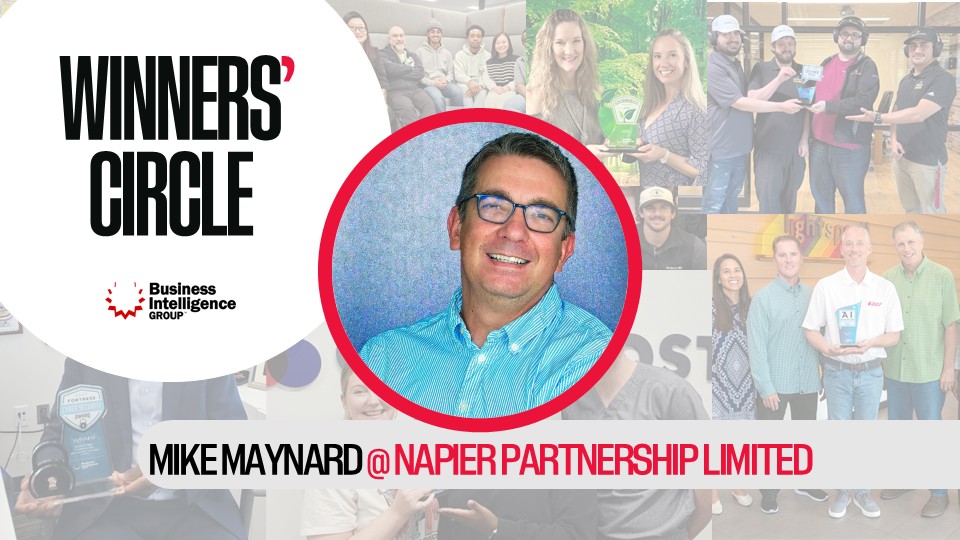

So here's a fact that ought to bug you a little: your company might be the real expert in your niche, and ChatGPT still has no idea you exist. That's basically the problem Mike Maynard, chairman of the B2B marketing agency Napier, came on the Winners' Circle Podcast to talk through with Russ Fordyce. Mike's been one of our Business Intelligence Group judges for years now, reading nominations and scoring them like, in his words, a little mini shark tank once a month. But this conversation wasn't about awards. It was about generative engine optimization, or GEO, and why so many otherwise smart B2B marketers are sitting this one out.
Mike didn't set out to run a marketing agency, actually. He started as an electronics design engineer, working on projects from radar systems to a mixing desk built for musician Kim Wilde, before he decided he was better at talking about products than designing them. That pushed him into technical sales, then marketing at a semiconductor company, and eventually into buying Napier outright in 2001, just a few weeks before the dot com crash hit. Rough timing, sure, but it forced the agency to grow slowly and stay cautious, and that same discipline still shows up in how Napier, now a team of more than 45 people founded back in 1984, thinks about new trends like AI visibility today. Mike ran Napier as owner for 24 years before becoming its Chairman in 2025, and he took on the Chairman role at Eurocom Worldwide, a global network of independent B2B agencies, that same year too. He also sits on the board of Coachable AI, an AI sales coaching platform, so he's not just writing about this stuff, he's actively building at the intersection of PR, martech and applied AI.
GEO Starts With the SEO You Already Should Have
Here's the thing Mike said that probably ought to be printed on a poster in every marketing department: if your SEO is bad, don't even bother with GEO yet. Fix the fundamentals first. That's the case since a lot of AI tools are still quietly searching the web behind the scenes when someone types a question into ChatGPT or Claude, so a site with strong organic search performance already has a head start. This whole practice, what people are now calling generative engine optimization or GEO for short, is still evolving fast, and Mike says the fundamentals matter more than the hacks.
Once the SEO foundation is solid, Mike says there are a handful of small, almost sneaky simple tactics that move the needle. Adding a well written FAQ section to the bottom of an article, for instance, measurably increases the odds an AI engine pulls from that page, and it also boosts what search folks now call semantic coherence, basically giving AI models a cleaner structure to pull from. He's tested it. It works. And unlike the old white hat, black hat SEO games from the 2000s, a decent FAQ or a set of key takeaways actually helps human readers too, so there's basically no real downside.
Recent data backs up how big the stakes have gotten here. AI Overviews now show up on close to half of all tracked Google queries, and when they do, click through rates on the page in position one drop by 58 percent, according to Ahrefs. People just aren't clicking through the way they used to anymore. If your content never gets pulled into that answer, it more or less stops existing for a huge chunk of your audience.
What a Thousand AI Prompts Taught Napier About Getting Cited
Mike and his team ran an actual study on this, not just a hunch. They built out more than a thousand prompts and ran them across four different AI engines to see which sources actually got cited for their niche, technical B2B clients. A few findings genuinely surprised him.
Reddit and Wikipedia, the two sources everybody talks about in generic GEO advice, barely mattered for Napier's clients. Makes sense once you think about it. Nobody's out there on Reddit debating the finer points of indium phosphide semiconductor chips. Instead, Napier found that YouTube carries a lot more weight than people expect, especially for Gemini, and that LinkedIn articles, a feature LinkedIn itself barely promotes anymore, get ranked surprisingly high by AI models.
That tracks with what other researchers are finding too. One analysis of citation patterns found large language models are now citing LinkedIn content roughly four times more often than before, with long form articles and newsletters making up the majority of it, according to Spotlight. So if your company has quietly let its LinkedIn newsletter go dormant, that might be worth a second look.
Mike's number one tip out of all of this, honestly, is simple and kind of embarrassing once you hear it. Companies need to actually mention their own brand name on their own website. It sounds obvious, but a shocking number of B2B sites default to we or our company instead of naming themselves, and if the brand name never shows up on the page, the AI engine has nothing to cite when it pulls information from that page. Mike calls it entity based authority, basically making sure AI engines see your brand as a distinct, citable entity, not just a page of clean copy.
Forget Attribution, Chase Incrementality Instead
Russ and Mike got into attribution too, and Mike's take here is refreshingly blunt. He basically doesn't care about last touch attribution anymore, since he thinks it's mostly misleading data dressed up as insight. What he actually cares about is incrementality, meaning did this marketing effort grow sales that wouldn't have happened otherwise.
His example was a Hi-Fi shop. If you ask customers what they saw right before buying, a lot will say the sign above the store. If you built your whole attribution model around that answer, you'd pour your entire budget into a fancier sign and miss every other channel that actually brought people in the door. Mike sees the same mistake happening with branded search ads today, where companies pay Google for clicks they would have gotten organically anyway, and attribution reports make it look like money well spent.
This lines up with what buyer research is showing right now too. Nearly three quarters of B2B buyers already use AI tools somewhere in their purchase research, and traffic coming from AI search is converting at more than five times the rate of regular organic search, according to a multi source analysis reported through PR Newswire. Half of B2B software buyers now say they start their research with an AI chatbot instead of Google, up sharply from a year earlier, per separate G2 research. That's a lot of buying behavior that traditional attribution models were never built to see.
Personalization Isn't Dead, the Timing Was Just Off
One of the more interesting turns in the conversation was around personalization. Mike thinks the martech industry sold everybody the wrong idea years ago, convincing marketers that dropping someone's first name and company into an email counted as real personalization. It doesn't move the needle much anymore, he says, since buyers got used to it fast.
What actually matters, according to Mike, is timing. He used his own recent car purchase as the example. Any car ad that hits his inbox now is basically wasted money, since he just bought one. Two months earlier, that same ad would have had a real shot at changing his mind. Most B2B marketing teams still struggle to figure out where a buyer sits in their purchase process, and that gap is quietly killing a lot of personalization efforts before they even start.
It's a good reminder that the martech stack itself isn't the whole problem. Mike's bigger frustration, honestly, is that so many of these tools just hand marketers a wall of numbers without any real insight attached. Moving from raw data to something you can actually act on, that's the skill gap he thinks the whole industry still needs to close.
Mike's still working the AI angle from a couple of directions these days too, including his board seat with the AI sales coaching platform Coachable, where reps can practice pitches against an AI instead of an awkward roleplay in front of their boss. Wherever he's looking, the theme stays the same: AI is genuinely reshaping how B2B buyers find and trust companies, and GEO is quickly becoming as basic a requirement as having a website at all.
Mike's been one of the sharpest and most generous judges in our Business Intelligence Group community for years, and conversations like this one are exactly why. If your company has a story worth telling the same way Napier's clients do, our nomination window is always open, and honestly, so is the door for marketers who want to help us judge them.
Want more conversations like this one? Subscribe to the Winners Circle Podcast and never miss an episode.