





So here is the uncomfortable truth about the events business, and honestly anyone who has worked a show floor already knows it. You spend months designing something beautiful, you truck it across the country, you build it in about eighteen hours, you stand in it for three days, and then you tear the whole thing down and a good chunk of it goes straight into a dumpster. It is, by almost any measure, one of the least sustainable industries on the planet. The Events Industry Council estimates the convention and trade show business generates roughly 600,000 tons of garbage a year, which puts it second only to construction.
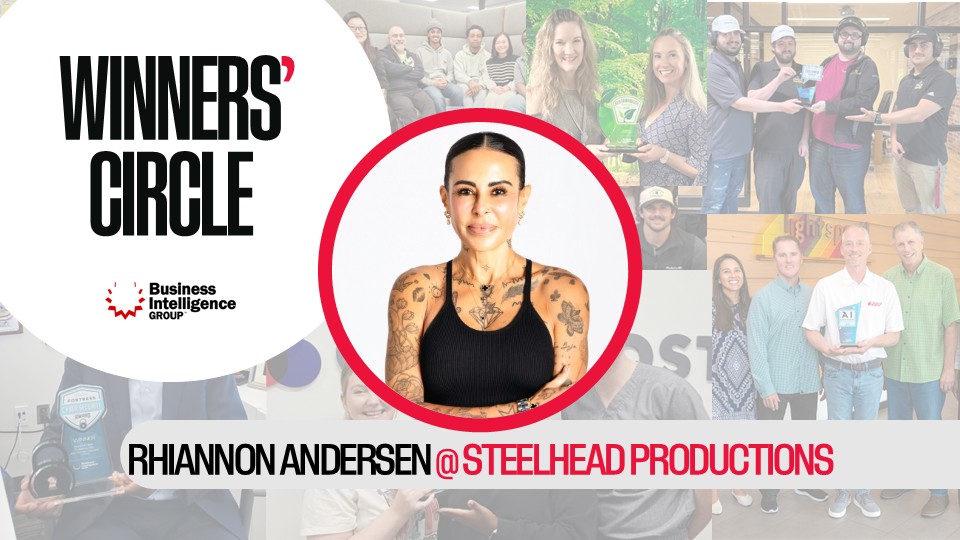
Rhiannon Andersen has been in that world for twenty-one years, and she is pretty blunt about it. "It's unfortunate that, you know, the lack of sustainability plagues, you know, the trade shows and events industry," she said on The Winners' Circle. "And it definitely isn't great, but it's evolving and we're happy to be a part of the evolution."
Steelhead Productions, which does business as Exhibit Happy, is a Las Vegas based exhibit design and build agency. And the reason they just picked up a Sustainability Award is not that they swapped in some recycled carpet and called it a day. They rebuilt the economics of the thing.
Rentals as the Base, Customization on Top
Back around 2008 and 2009, the team started noticing something that sounds obvious once you say it out loud. Most trade show booths are made of the same handful of things. "An exhibit tends to be some walls, a demo station here and there, a registration desk, a theater," Rhiannon explained. "Many components are used very similarly and can very well be customized with graphic applications and different technology utilizations."
So they doubled down on renting the bones and customizing the skin. They call it the access model, and the pitch is basically this: I have this thing, you use something similar, your competitor uses something similar, but everything we overlay on top makes each one look completely custom. The client gets a booth that looks like it was built for them, because visually it was. The components go back into inventory instead of into a landfill.
What is interesting is that this was not originally a sustainability play. The founder, Rhiannon's dad, just had a principle around reuse. It took the team recognizing that they were "throwing away the majority of the components well before their life cycle was over" to turn a personal principle into the center of the whole company. And it turns out the market rewarded it. "Our model is very appealing to a lot of people who care about the planet," she said, which lines up with what procurement data is showing more broadly, since roughly 65 percent of buyers now expect suppliers to meet defined sustainability standards.
Then They Went and Got B Corp Certified
Steelhead is a certified B Corporation, and as far as Rhiannon knows they are the only exhibit house in the United States that can say that. If you have never gone through it, B Corp is a third party accreditation that evaluates for profit companies on how they treat people and the planet across a genuinely exhausting list of metrics. It took Steelhead about nine months just to complete the application. They are now heading into their fourth year certified.
For context on how rare that still is, there were only about 8,051 certified B Corps worldwide as of 2023, which is a tiny number when you consider how many businesses exist on Earth. "It's made us a better company for sure," Rhiannon said, "but it's not easy."
Sustainability That Reaches Every Single Department
Here is the part that I think most owners underestimate. When Steelhead leaned into the B Corp process, they did not treat sustainability as a marketing department project. They ran it through all thirteen departments in the company, and they asked each one what it could actually change.
On site supervisors used to carry a giant binder of project plans to every show, and every single one of those binders went in the garbage at the end of the build. Now the crew has iPads. They looked at the building itself, the toilets, the hand dryers versus paper towels, the climate control. Rhiannon makes a point about scale that stuck with me. One bathroom's worth of paper towels seems irrelevant. Six bathrooms and a hundred people using them adds up to rolls and rolls and rolls every month.
The water bottle number is the one people react to. They installed one of those filtered filling stations with a counter on it, the kind you see in airports, in their kitchen. "I think year to date, we've diverted something like thirty thousand plastic bottles from going into the landfill by just installing one of those in our kitchen," she said. One machine. One kitchen.
And she is honest about what that actually required, which I appreciated. Buying and installing that machine came out of net profit, which meant three owners had to agree to spend their own distribution money on it. "Do we spend take that money and keep it in the savings account or take it as a distribution as owners," she asked, "or do we invest in in the planet that we all call home?"
If You Do Not Measure It, It Is Not Real
Steelhead cut energy use per employee by about sixty percent while the company was growing and the building was getting bigger, which is the hard version of that trick. When I asked what the hardest part of running a business this measured actually is, her answer was not what I expected. It is not the measuring. It is deciding how to measure, and then getting people to keep doing it.
"You have to get, you know, thirteen leaders of departments all to row in the same direction," she said. The events industry is brutally cyclical, so there are months where everybody is working sixty to eighty hours, and somebody still has to pull the kilowatt number. Her rule is simple and kind of unforgiving: "You can't just care about it one month and not care about it the next month." Steelhead reports sustainability metrics at a company wide team meeting every single month, so nobody gets to quietly let it slide.
The People Side Is Not a Separate Program
Steelhead has been named one of Nevada's best places to work for six years running, and they have picked up Inc. best workplace honors twice. What they do for staff is unusually broad. Financial coaches who help people raise their credit scores and apply for home loans. A massage therapist. A nutritionist. A company hydration challenge with an app and actual prizes.
They also pay people to volunteer. There is an employee run group called the Give Happy Committee that organizes quarterly service work, and they have been running it for something like a decade. Food drives, Habitat for Humanity, decorating hospital rooms, cleaning up trails around Red Rock. That kind of program tends to pay for itself, since employees who participate in company volunteer programs are about 52 percent less likely to leave. Steelhead's own attrition backs it up. They have people at nine, thirteen, and eighteen years.
Why Any of This Matters Right Now
Face to face is having a real moment again. More than half of event organizers expect bigger in person budgets, and the share of organizations planning more in person experiences jumped to 66 percent. As AI pushes more of our work into screens, people seem to want rooms again. Rhiannon sees it in her pipeline, and she also sees the expectations changing. The old cookie cutter corporate booth is fading out, and something more hospitality driven is taking its place.
Her advice to another owner who wants to build a sustainability program is refreshingly unglamorous. Do not start with tactics. Start with what you and your partners actually value, and then build the program around that, because anything else becomes a here today gone tomorrow initiative that nobody believes in. "It takes showing up and showing up and showing up," she said, "for people to really have faith in that's the type of company that you are."
Congratulations to Rhiannon and the whole Steelhead crew on the Sustainability Award. Doing this in the world's least sustainable industry is the hard version.
Want more conversations with the people actually building this stuff? Subscribe to The Winners' Circle at bintelligence.com/podcast.